Fixed-point property
A mathematical object has the fixed-point property if every suitably well-behaved mapping from to itself has a fixed point. The term is most commonly used to describe topological spaces on which every continuous mapping has a fixed point. But another use is in order theory, where a partially ordered set is said to have the fixed point property if every increasing function on has a fixed point.


Definition
Let be an object in the concrete category . Then has the fixed-point property if every morphism (i.e., every function) has a fixed point.


The most common usage is when is the category of topological spaces. Then a topological space has the fixed-point property if every continuous map has a fixed point.


Examples
Singletons
In the category of sets, the objects with the fixed-point property are precisely the singletons.
The closed interval
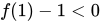
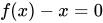
The closed interval has the fixed point property: Let be a continuous mapping. If or , then our mapping has a fixed point at 0 or 1. If not, then and . Thus the function is a continuous real valued function which is positive at and negative at . By the intermediate value theorem, there is some point with , which is to say that , and so is a fixed point.
![{\displaystyle [0,1]}](https://wikimedia.org/api/rest_v1/media/math/render/svg/738f7d23bb2d9642bab520020873cccbef49768d)
![{\displaystyle f:[0,1]\to [0,1]}](https://wikimedia.org/api/rest_v1/media/math/render/svg/f64956bbc19d5bbe642fd7bf4f1aa62487006f4d)




The open interval does not have the fixed-point property. The mapping has no fixed point on the interval .


The closed disc
The closed interval is a special case of the closed disc, which in any finite dimension has the fixed-point property by the Brouwer fixed-point theorem.
Topology
A retract of a space with the fixed-point property also has the fixed-point property. This is because if is a retraction and is any continuous function, then the composition (where is inclusion) has a fixed point. That is, there is such that . Since we have that and therefore




A topological space has the fixed-point property if and only if its identity map is universal.
A product of spaces with the fixed-point property in general fails to have the fixed-point property even if one of the spaces is the closed real interval.
The FPP is a topological invariant, i.e. is preserved by any homeomorphism. The FPP is also preserved by any retraction.
According to the Brouwer fixed-point theorem, every compact and convex subset of a Euclidean space has the FPP. More generally, according to the Schauder-Tychonoff fixed point theorem every compact and convex subset of a locally convex topological vector space has the FPP. Compactness alone does not imply the FPP and convexity is not even a topological property so it makes sense to ask how to topologically characterize the FPP. In 1932 Borsuk asked whether compactness together with contractibility could be a sufficient condition for the FPP to hold. The problem was open for 20 years until the conjecture was disproved by Kinoshita who found an example of a compact contractible space without the FPP.[1]
References
- ^ Kinoshita, S. On Some Contractible Continua without Fixed Point Property. Fund. Math. 40 (1953), 96–98
- Samuel Eilenberg, Norman Steenrod (1952). Foundations of Algebraic Topology. Princeton University Press.
- Schröder, Bernd (2002). Ordered Sets. Birkhäuser Boston.
Content Disclaimer
Informasi ini disarikan dari Wikipedia dan disajikan kembali untuk tujuan edukasi. Konten tersedia di bawah lisensi CC BY-SA 3.0. Kami tidak bertanggung jawab atas ketidakakuratan data yang bersumber dari kontribusi publik tersebut.
- The information displayed on this website is sourced in part or in whole from Wikipedia and has been adapted for the purpose of restating it. We strive to provide accurate and relevant information, however:
- There is no guarantee of absolute accuracy. Wikipedia is an open, collaborative project that can be edited by anyone, so information is subject to change.
- It is not intended to constitute professional advice. The content displayed is for informational and educational purposes only. For important decisions (e.g., medical, legal, or financial), please consult a professional.
- Content copyright. Wikipedia is licensed under the Creative Commons Attribution-ShareAlike License (CC BY-SA). This means that content may be reused with appropriate attribution and shared under a similar license.
- Responsible use. Any risk arising from the use of information from this website is entirely the responsibility of the user.