Ferocactus latispinus
| Ferocactus latispinus | |
|---|---|

| |
| Ferocactus latispinus in flower | |
Scientific classification 
| |
| Kingdom: | Plantae |
| Clade: | Embryophytes |
| Clade: | Tracheophytes |
| Clade: | Spermatophytes |
| Clade: | Angiosperms |
| Clade: | Eudicots |
| Order: | Caryophyllales |
| Family: | Cactaceae |
| Subfamily: | Cactoideae |
| Genus: | Ferocactus |
| Species: | F. latispinus
|
| Binomial name | |
| Ferocactus latispinus | |
| Synonyms | |
| |

Ferocactus latispinus is a species of barrel cactus native to Mexico.
Description
Ferocactus latispinus grows as a single globular light green cactus reaching the dimensions of 30 centimetres (12 in) to 1 meter in height and 40 centimetres (16 in) across, with 21 acute ribs. Its spines range from reddish to white in color and are flattened. The four central spines growing up to 4–5 centimetres (1.6–2.0 in) long and 4–9 millimetres (0.16–0.35 in) wide and 5-15 marginal spines that are straight or recurved. Flowering is in late autumn or early winter.[2] The funnel-shaped flowers are purplish or yellowish and reach 4 cm long, and are followed by oval-shaped scaled fruit which reach 2.5 centimetres (0.98 in) long.[3]
-
 Flower
 -
 Spines closeup
 -
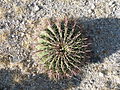 Plant
Plant -
 Clump of plants
.jpg)

.jpg)

Subspecies
Two subspecies are recognised, differing in their number of radial spines.[3]
| Image | Name | Description | Distribution |
|---|---|---|---|
.jpg) |
Ferocactus latispinus subsp. greenwoodii (Glass) N.P.Taylor | 4-5 radial spines | Mexico (Oaxaca) |
.jpg) |
Ferocactus latispinus subsp. latispinus | 9–15 radial spines, Devil's Tongue Barrel or Crow's Claw Cactus.[2] | Mexico (Durango to Puebla) |
.jpg) |
Ferocactus latispinus subsp. spiralis (Karw. ex Pfeiff.) N.P.Taylor | grows up to 1 meter tall, 5–7 radial spines | Mexico (Veracruz, Puebla, Oaxaca). |
Distribution
The species is endemic to Mexico; the more widely distributed subspecies latispinus ranges from southeastern Durango, through Zacatecas, Aguascalientes, east to the western parts of San Luis Potosí, Hidalgo and Puebla, as well as to eastern Jalisco, Guanajuato, Querétaro and Mexico State. Subspecies spiralis is restricted to the southern parts of Oaxaca and Puebla.[3] This species is typically found under nurse plants like tree canopies and shrubs. Plants are found growing in oak forest, grasslands, silt flats, and in rocky outcrops at elevations of 600 to 2,600 metres (2,000 to 8,500 ft).[4] These nurse plants protect these smaller plant species below them from harsh weather conditions; being able to provide shade for the cacti in arid and sunny environments. [5]
-
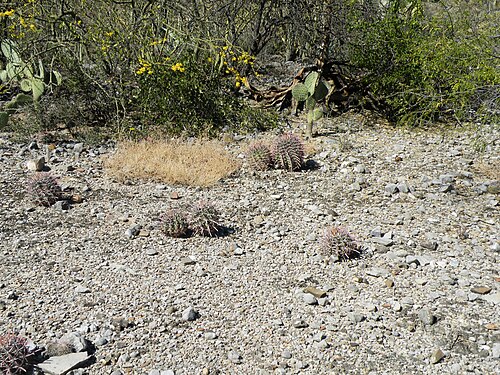 F. recurvus habitat in Zapotitlan De Las Salinas, Puebla
 -
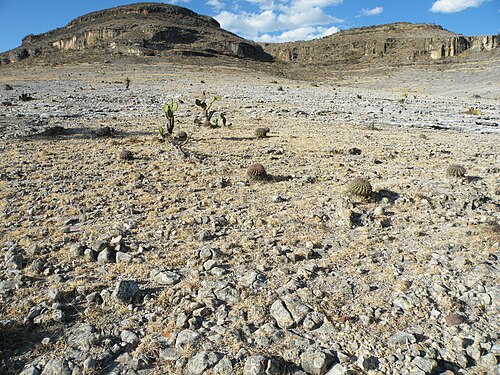 Habitat near Concepcion buenavista, Oaxaca
 -
 Plants growing in grasslands with oaks near Teotongo, Oaxaca
.jpg)
.jpg)
.jpg)
Taxonomy
Originally described as Cactus latispinus in 1824 by English naturalist Adrian Hardy Haworth, it gained its current name in 1922 with the erection of the genus Ferocactus by American botanists Britton and Rose.[3] The species name is derived from the Latin latus "broad", and spinus "spine". Ferocactus recurvus is a former name for the species.[3]
Cultivation
Ferocactus latispinus is fairly commonly cultivated as an ornamental plant. It blooms at an early age which is a desirable horticultural feature. It is hardy to −4 °C, with an average minimum temperature of 10 °C.[2]
The slime mold, Didymium wildpretii feeds on the decaying remains of F. latispinus in Mexico.[6]
References
- ^ Biología, Héctor Hernández (Instituto de; Group), Succulent Plants Specialist; Group), Succulent Plants Specialist (2009-11-18). "The IUCN Red List of Threatened Species". IUCN Red List of Threatened Species. Retrieved 2024-01-17.
- ^ a b c "Devil's Tongue Barrel, Crow's Claw Cactus". Desert Tropicals website. Archived from the original on 19 April 2000. Retrieved 28 August 2010.
- ^ a b c d e Anderson, Edward F. (2001). The cactus family. Timber Press. p. 332. ISBN 0-88192-498-9. Retrieved 28 August 2010.
- ^ "Ferocactus latispinus". LLIFLE. 2013-08-04. Retrieved 2024-01-17.
- ^ Córdova-Acosta, E et al. “Reproductive Biology of Ferocactus Recurvus (Mill.) Borg Subsp. Recurvus (Cactaceae) in the Tehuacán-Cuicatlán Valley, Mexico.” Plant biology (Stuttgart, Germany) 19.5 (2017): 798–805. Web.
- ^ Lado, C.; Mosquera, J.; Estrada-Torres, A.; Beltran-Tejera, E.; De Basanta, D. W. (2007). "Description and culture of a new succulenticolous Didymium (Myxomycetes)". Mycologia. 99 (4): 602–611. doi:10.3852/mycologia.99.4.602. PMID 18065011.
External links
 Media related to Ferocactus latispinus at Wikimedia Commons
 Data related to Ferocactus latispinus at Wikispecies


Content Disclaimer
Informasi ini disarikan dari Wikipedia dan disajikan kembali untuk tujuan edukasi. Konten tersedia di bawah lisensi CC BY-SA 3.0. Kami tidak bertanggung jawab atas ketidakakuratan data yang bersumber dari kontribusi publik tersebut.
- The information displayed on this website is sourced in part or in whole from Wikipedia and has been adapted for the purpose of restating it. We strive to provide accurate and relevant information, however:
- There is no guarantee of absolute accuracy. Wikipedia is an open, collaborative project that can be edited by anyone, so information is subject to change.
- It is not intended to constitute professional advice. The content displayed is for informational and educational purposes only. For important decisions (e.g., medical, legal, or financial), please consult a professional.
- Content copyright. Wikipedia is licensed under the Creative Commons Attribution-ShareAlike License (CC BY-SA). This means that content may be reused with appropriate attribution and shared under a similar license.
- Responsible use. Any risk arising from the use of information from this website is entirely the responsibility of the user.