Face Animation Parameter
A Face Animation Parameter (FAP) is a component of the MPEG-4 Face and Body Animation (FBA) International Standard (ISO/IEC 14496-1 & -2) developed by the Moving Pictures Experts Group.[1] It describes a standard for virtually representing humans and humanoids in a way that adequately achieves visual speech intelligibility as well as the mood and gesture of the speaker, and allows for very low bitrate compression and transmission of animation parameters.[2] FAPs control key feature points on a face model mesh that are used to produce animated visemes and facial expressions, as well as head and eye movement.[1] These feature points are part of the Face Definition Parameters (FDPs) also defined in the MPEG-4 standard.[3]
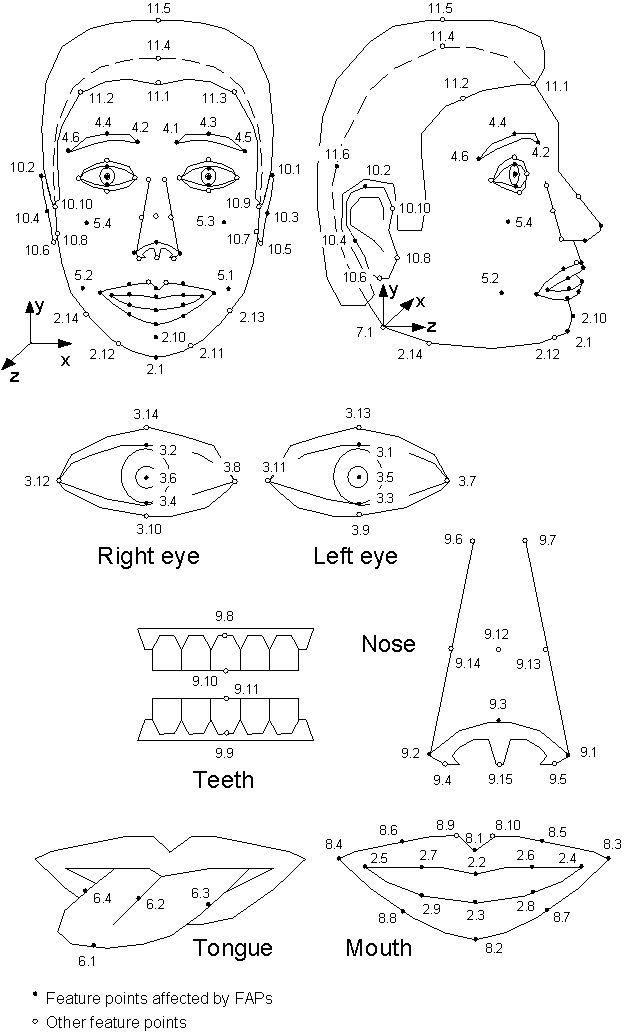
FAPs represent 66 displacements and rotations of the feature points from the neutral face position, which is defined as: mouth closed, eyelids tangent to the iris, gaze and head orientation straight ahead, teeth touching, and tongue touching teeth.[4] These FAPs were designed to be closely related to human facial muscle movements. In addition to animation, FAPs are used in automatic speech recognition,[5] and biometrics.[6]
References
- ^ a b Ostermann, Jörn (August 2002). "Chapter 2: Face Animation in MPEG-4". In Pandzic, Igor; Forchheimer, Robert (eds.). MPEG-4 Facial Animation: The Standard, Implementation and Applications. Wiley. pp. 17–55. ISBN 978-0-470-84465-6.
- ^ Tao, Hai; Chen, H.H.; Wu, Wei; Huang, T.S. (1999). "Compression of MPEG-4 facial animation parameters for transmission of talking heads". IEEE Transactions on Circuits and Systems for Video Technology. 9 (3). IEEE Press: 264–276. doi:10.1109/76.752094.
- ^ Kshirsagar, Sumedha; Garchery, Stephane; Magnenat-Thalmann, Nadia (2001). "Feature Point Based Mesh Deformation Applied to MPEG-4 Facial Animation". Deformable Avatars: 24–34.
- ^ Petajan, Eric (September 2005). "MPEG-4 Face and Body Animation Coding Applied to HCI". In Kisačanin, B.; Pavlović, V.; Wang, T.S. (eds.). Real-time vision for human-computer interaction. Springer. pp. 249–268. ISBN 0387276971.
- ^ Petajan, Eric (January 1, 2009). "Chapter 4: Visual Speech and Gesture Coding Using the MPEG-4 Face and Body Animation Standard". In Wee-Chung Liew, Alan (ed.). Visual Speech Recognition: Lip Segmentation and Mapping. IGI Global. pp. 128–148. ISBN 9781605661872.
- ^ Aleksic, P.S.; Katsaggelos, A.K. (November 2006). "Audio-Visual Biometrics". Proceedings of the IEEE. 94 (11). IEEE Press: 2025–2044. doi:10.1109/JPROC.2006.886017.
External links
- The Moving Picture Experts Group Website Archived 2016-01-01 at the Wayback Machine
 | This animation-related article is a stub. You can help Wikipedia by adding missing information. |
Content Disclaimer
Informasi ini disarikan dari Wikipedia dan disajikan kembali untuk tujuan edukasi. Konten tersedia di bawah lisensi CC BY-SA 3.0. Kami tidak bertanggung jawab atas ketidakakuratan data yang bersumber dari kontribusi publik tersebut.
- The information displayed on this website is sourced in part or in whole from Wikipedia and has been adapted for the purpose of restating it. We strive to provide accurate and relevant information, however:
- There is no guarantee of absolute accuracy. Wikipedia is an open, collaborative project that can be edited by anyone, so information is subject to change.
- It is not intended to constitute professional advice. The content displayed is for informational and educational purposes only. For important decisions (e.g., medical, legal, or financial), please consult a professional.
- Content copyright. Wikipedia is licensed under the Creative Commons Attribution-ShareAlike License (CC BY-SA). This means that content may be reused with appropriate attribution and shared under a similar license.
- Responsible use. Any risk arising from the use of information from this website is entirely the responsibility of the user.