Fabius function

In mathematics, the Fabius function is an example of an infinitely differentiable function that is nowhere analytic, found by Jaap Fabius (1966).
This function satisfies the initial condition , the symmetry condition for , and the functional differential equation



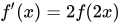
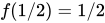
for . It follows that is monotone increasing for , with and and and . All derivatives are zero at 0, i.e. , and are also all zero at all positive integers.




It was also written down as the Fourier transform of
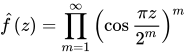
by Børge Jessen and Aurel Wintner (1935).
The Fabius function is defined on the unit interval, and is given by the cumulative distribution function of

where the ξn are independent uniformly distributed random variables on the unit interval. That distribution has an expectation of and a variance of .


There is a unique extension of f to the real numbers that satisfies the same differential equation for all x. This extension can be defined by f(x) = 0 for x ≤ 0, f(x + 1) = 1 − f(x) for 0 ≤ x ≤ 1, and f(x + 2r) = −f(x) for 0 ≤ x ≤ 2r with r a positive integer. The sequence of intervals within which this function is positive or negative follows the same pattern as the Thue–Morse sequence.
The Rvachëv up function[1] is closely related to the Fabius function f: It fulfills the delay differential equation[2] (See Delay differential equation for another example.)


Values
The Fabius function is constant zero for all non-positive arguments, and assumes rational values at positive dyadic rational arguments. For example:[3][4]


with the numerators listed in OEIS: A272755 and denominators in OEIS: A272757.
Asymptotic

for , where is Euler's constant, and is the Stieltjes constant. Equivalently,


for .

References
- ^ "A288163 – Oeis".
- ^ Juan Arias de Reyna (2017). "Arithmetic of the Fabius function". arXiv:1702.06487 [math.NT].
- ^ Sloane, N. J. A. (ed.). "Sequence A272755 (Numerators of the Fabius function F(1/2^n))". The On-Line Encyclopedia of Integer Sequences. OEIS Foundation.
- ^ Sloane, N. J. A. (ed.). "Sequence A272757 (Denominators of the Fabius function F(1/2^n))". The On-Line Encyclopedia of Integer Sequences. OEIS Foundation.
- Fabius, J. (1966), "A probabilistic example of a nowhere analytic C∞-function", Zeitschrift für Wahrscheinlichkeitstheorie und Verwandte Gebiete, 5 (2): 173–174, doi:10.1007/bf00536652, MR 0197656, S2CID 122126180
- Jessen, Børge; Wintner, Aurel (1935), "Distribution functions and the Riemann zeta function", Trans. Amer. Math. Soc., 38: 48–88, doi:10.1090/S0002-9947-1935-1501802-5, MR 1501802
- Dimitrov, Youri (2006). Polynomially-divided solutions of bipartite self-differential functional equations (Thesis).
- Arias de Reyna, Juan (2017). "Arithmetic of the Fabius function". arXiv:1702.06487 [math.NT].
- Arias de Reyna, Juan (2017). "An infinitely differentiable function with compact support: Definition and properties". arXiv:1702.05442 [math.CA]. (an English translation of the author's paper published in Spanish in 1982)
- Alkauskas, Giedrius (2001), Dirichlet series associated with Thue–Morse sequence, preprint.
- Rvachev, V. L.; Rvachev, V. A. (1979), Non-classical methods of the approximation theory in boundary value problems (in Russian), Kiev: Naukova Dumka
 | This mathematical analysis–related article is a stub. You can help Wikipedia by adding missing information. |
Content Disclaimer
Informasi ini disarikan dari Wikipedia dan disajikan kembali untuk tujuan edukasi. Konten tersedia di bawah lisensi CC BY-SA 3.0. Kami tidak bertanggung jawab atas ketidakakuratan data yang bersumber dari kontribusi publik tersebut.
- The information displayed on this website is sourced in part or in whole from Wikipedia and has been adapted for the purpose of restating it. We strive to provide accurate and relevant information, however:
- There is no guarantee of absolute accuracy. Wikipedia is an open, collaborative project that can be edited by anyone, so information is subject to change.
- It is not intended to constitute professional advice. The content displayed is for informational and educational purposes only. For important decisions (e.g., medical, legal, or financial), please consult a professional.
- Content copyright. Wikipedia is licensed under the Creative Commons Attribution-ShareAlike License (CC BY-SA). This means that content may be reused with appropriate attribution and shared under a similar license.
- Responsible use. Any risk arising from the use of information from this website is entirely the responsibility of the user.