Exponentially equivalent measures
In mathematics, exponential equivalence of measures is how two sequences or families of probability measures are "the same" from the point of view of large deviations theory.
Definition
Let be a metric space and consider two one-parameter families of probability measures on , say and . These two families are said to be exponentially equivalent if there exist


- a one-parameter family of probability spaces ,
- two families of -valued random variables and ,
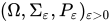


such that
- for each , the -law (i.e. the push-forward measure) of is , and the -law of is ,
- for each , " and are further than apart" is a -measurable event, i.e.



- for each ,

The two families of random variables and are also said to be exponentially equivalent.
Properties
The main use of exponential equivalence is that as far as large deviations principles are concerned, exponentially equivalent families of measures are indistinguishable. More precisely, if a large deviations principle holds for with good rate function , and and are exponentially equivalent, then the same large deviations principle holds for with the same good rate function .

References
- Dembo, Amir; Zeitouni, Ofer (1998). Large deviations techniques and applications. Applications of Mathematics (New York) 38 (Second ed.). New York: Springer-Verlag. pp. xvi+396. ISBN 0-387-98406-2. MR 1619036. (See section 4.2.2)
Content Disclaimer
Informasi ini disarikan dari Wikipedia dan disajikan kembali untuk tujuan edukasi. Konten tersedia di bawah lisensi CC BY-SA 3.0. Kami tidak bertanggung jawab atas ketidakakuratan data yang bersumber dari kontribusi publik tersebut.
- The information displayed on this website is sourced in part or in whole from Wikipedia and has been adapted for the purpose of restating it. We strive to provide accurate and relevant information, however:
- There is no guarantee of absolute accuracy. Wikipedia is an open, collaborative project that can be edited by anyone, so information is subject to change.
- It is not intended to constitute professional advice. The content displayed is for informational and educational purposes only. For important decisions (e.g., medical, legal, or financial), please consult a professional.
- Content copyright. Wikipedia is licensed under the Creative Commons Attribution-ShareAlike License (CC BY-SA). This means that content may be reused with appropriate attribution and shared under a similar license.
- Responsible use. Any risk arising from the use of information from this website is entirely the responsibility of the user.