Exner function
The Exner function is a parameter used in atmospheric modeling. Depending on the application, the Exner function may be defined as

or as a non-dimensional form
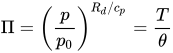
where is a standard reference surface pressure (usually taken as 1000 hPa, but sometimes as the surface pressure); is the specific gas constant for dry air; is the specific heat capacity of dry air at constant pressure; is the absolute temperature; and is the potential temperature.[1][2][3] The non-dimensional form can be used as a vertical coordinate in some numerical weather prediction applications, resulting in a simpler mathematical formulation compared to using pressure as the vertical coordinate.[2] It is named after Felix Maria von Exner-Ewarten.[4]


References
- ^ Holton, James R. (2004). An Introduction to Dynamic Meteorology. Burlington, MA: Elsevier Academic Press. p. 109. ISBN 978-0-12-354015-7. Retrieved 2025-11-18.
- ^ a b Bluestein, Howard B. (2013). Severe Convective Storms and Tornadoes. London: Springer-Verlag. pp. 60–61. ISBN 978-3-642-05381-8. Retrieved 2025-11-18.
- ^ "CF Standard Name Table". CF Metadata Conventions. 2025-07-24. Retrieved 2025-11-18.
The term "Exner function" is applied to various quantities in the literature. "Dimensionless Exner function" is the standard name of (p/p0)^(R/Cp), where p is pressure, p0 a reference pressure, R the gas constant and Cp the specific heat at constant pressure. This quantity is also the ratio of in-situ to potential temperature.
- ^ Koertge, Noretta (2008). "EXNER-EWARTEN, FELIX MARIA VON" (PDF). New Dictionary of Scientific Biography. Retrieved 2025-11-18.
See also
- Barometric formula
- Climate model
- Euler equations
- Fluid dynamics
- General circulation model
- Numerical weather prediction
- Primitive equations
 | This article about atmospheric science is a stub. You can help Wikipedia by adding missing information. |
Content Disclaimer
Informasi ini disarikan dari Wikipedia dan disajikan kembali untuk tujuan edukasi. Konten tersedia di bawah lisensi CC BY-SA 3.0. Kami tidak bertanggung jawab atas ketidakakuratan data yang bersumber dari kontribusi publik tersebut.
- The information displayed on this website is sourced in part or in whole from Wikipedia and has been adapted for the purpose of restating it. We strive to provide accurate and relevant information, however:
- There is no guarantee of absolute accuracy. Wikipedia is an open, collaborative project that can be edited by anyone, so information is subject to change.
- It is not intended to constitute professional advice. The content displayed is for informational and educational purposes only. For important decisions (e.g., medical, legal, or financial), please consult a professional.
- Content copyright. Wikipedia is licensed under the Creative Commons Attribution-ShareAlike License (CC BY-SA). This means that content may be reused with appropriate attribution and shared under a similar license.
- Responsible use. Any risk arising from the use of information from this website is entirely the responsibility of the user.