Exchange operator
 | This article needs additional citations for verification. (February 2016) |
| Part of a series of articles about |
| Quantum mechanics |
|---|
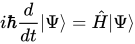
In quantum mechanics, the exchange operator , also known as permutation operator,[1] is a quantum mechanical operator that acts on states in Fock space. The exchange operator acts by switching the labels on any two identical particles described by the joint position quantum state .[2] Since the particles are identical, the notion of exchange symmetry requires that the exchange operator be unitary.


Construction


In three or higher dimensions, the exchange operator can represent a literal exchange of the positions of the pair of particles by motion of the particles in an adiabatic process, with all other particles held fixed. Such motion is often not carried out in practice. Rather, the operation is treated as a "what if" similar to a parity inversion or time reversal operation. Consider two repeated operations of such a particle exchange:


Therefore, is not only unitary but also an operator square root of 1, which leaves the possibilities

Both signs are realized in nature. Particles satisfying the case of +1 are called bosons, and particles satisfying the case of −1 are called fermions. The spin–statistics theorem dictates that all particles with integer spin are bosons whereas all particles with half-integer spin are fermions.
The exchange operator commutes with the Hamiltonian and is therefore a conserved quantity. Therefore, it is always possible and usually most convenient to choose a basis in which the states are eigenstates of the exchange operator. Such a state is either completely symmetric under exchange of all identical bosons or completely antisymmetric under exchange of all identical fermions of the system. To do so for fermions, for example, the antisymmetrizer builds such a completely antisymmetric state.
In 2 dimensions, the adiabatic exchange of particles is not necessarily possible. Instead, the eigenvalues of the exchange operator may be complex phase factors (in which case is not Hermitian), see anyon for this case. The exchange operator is not well defined in a strictly 1-dimensional system, though there are constructions of 1-dimensional networks that behave as effective 2-dimensional systems.
Quantum chemistry
In the Hartree–Fock method of quantum chemistry, the exchange operator is usually defined as:

where is exchange operator, is the -th orbital, and is a one-electron orbital acted by . The above expression reflects the exchange between the electrons on the -th and -th orbitals.


See also
- Exchange interaction
- Hamiltonian (quantum mechanics)
- Coulomb operator
- Exchange symmetry or permutation symmetry
References
- ^ Levine, I.N., Quantum Chemistry (4th ed., Prentice Hall 1991) p.262. ISBN 0-205-12770-3
- ^ J.S. Townsend (2000). A modern approach to quantum mechanics. International series in pure and applied physics. Vol. 69 (2 ed.). University Science Books. p. 342. ISBN 978-1891389139.
- K. Kitaura; K. Morokuma (2004). "A new energy decomposition scheme for molecular interactions within the Hartree-Fock approximation". International Journal of Quantum Chemistry. 10 (2). Wiley: 325–340. doi:10.1002/qua.560100211.
- Bylander, D. M.; Kleinman, Leonard (1990). "Good semiconductor band gaps with a modified local-density approximation". Physical Review B. 41 (11): 7868–7871. Bibcode:1990PhRvB..41.7868B. doi:10.1103/PhysRevB.41.7868. PMID 9993089.
- A.P. Polychronakos (1992). "Exchange Operator Formalism for Integrable Systems of Particles". Phys. Rev. Lett. 69 (5): 703–705. arXiv:hep-th/9202057. Bibcode:1992PhRvL..69..703P. doi:10.1103/PhysRevLett.69.703. PMID 10047011. S2CID 14319416.
- Szépfalusy, P. (1957). "On a new exchange potential". Acta Physica Academiae Scientiarum Hungaricae. 7 (3): 357–364. doi:10.1007/BF03156345. S2CID 124672448.
- R.K. Nesbet (1958). "The Heisenberg exchange operator for ferromagnetic and antiferromagnetic systems". Annals of Physics. 4 (1). Lincoln, Massachusetts, USA: Elsevier: 87–103. Bibcode:1958AnPhy...4...87N. doi:10.1016/0003-4916(58)90039-3.
- "The Hartree-Fock Equation".
External links
Content Disclaimer
Informasi ini disarikan dari Wikipedia dan disajikan kembali untuk tujuan edukasi. Konten tersedia di bawah lisensi CC BY-SA 3.0. Kami tidak bertanggung jawab atas ketidakakuratan data yang bersumber dari kontribusi publik tersebut.
- The information displayed on this website is sourced in part or in whole from Wikipedia and has been adapted for the purpose of restating it. We strive to provide accurate and relevant information, however:
- There is no guarantee of absolute accuracy. Wikipedia is an open, collaborative project that can be edited by anyone, so information is subject to change.
- It is not intended to constitute professional advice. The content displayed is for informational and educational purposes only. For important decisions (e.g., medical, legal, or financial), please consult a professional.
- Content copyright. Wikipedia is licensed under the Creative Commons Attribution-ShareAlike License (CC BY-SA). This means that content may be reused with appropriate attribution and shared under a similar license.
- Responsible use. Any risk arising from the use of information from this website is entirely the responsibility of the user.