Estimation lemma
In complex analysis, the estimation lemma, also known as the ML inequality (ML for Max times Length), gives an upper bound for a contour integral. If f is a complex-valued, continuous function on the contour Γ and if its absolute value |f (z)| is bounded by a constant M for all z on Γ, then
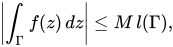
where l(Γ) is the arc length of Γ. In particular, we may take the maximum
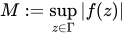
as upper bound. Intuitively, the lemma is very simple to understand. If a contour is thought of as many smaller contour segments connected together, then there will be a maximum |f (z)| for each segment. Out of all the maximum |f (z)|s for the segments, there will be an overall largest one. Hence, if the overall largest |f (z)| is summed over the entire path then the integral of f (z) over the path must be less than or equal to it.
Formally, the inequality can be shown to hold using the definition of contour integral, the absolute value inequality for integrals and the formula for the length of a curve as follows:

The estimation lemma is most commonly used as part of the methods of contour integration with the intent to show that the integral over part of a contour goes to zero as |z| goes to infinity. An example of such a case is shown below.
Example

Problem. Find an upper bound for
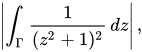
where Γ is the upper half-circle |z| = a with radius a > 1 traversed once in the counterclockwise direction.
Solution. First observe that the length of the path of integration is half the circumference of a circle with radius a, hence

Next we seek an upper bound M for the integrand when |z| = a. By the triangle inequality we see that

therefore

because |z| = a > 1 on Γ. Hence
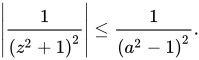
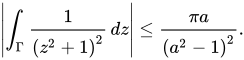
Therefore, we apply the estimation lemma with M = 1/(a2 − 1)2. The resulting bound is
See also
References
- Saff, E.B; Snider, A.D. (1993), Fundamentals of Complex Analysis for Mathematics, Science, and Engineering (2nd ed.), Prentice Hall, ISBN 978-0133274615.
- Howie, J.M. (2003), Complex Analysis, Springer.
Content Disclaimer
Informasi ini disarikan dari Wikipedia dan disajikan kembali untuk tujuan edukasi. Konten tersedia di bawah lisensi CC BY-SA 3.0. Kami tidak bertanggung jawab atas ketidakakuratan data yang bersumber dari kontribusi publik tersebut.
- The information displayed on this website is sourced in part or in whole from Wikipedia and has been adapted for the purpose of restating it. We strive to provide accurate and relevant information, however:
- There is no guarantee of absolute accuracy. Wikipedia is an open, collaborative project that can be edited by anyone, so information is subject to change.
- It is not intended to constitute professional advice. The content displayed is for informational and educational purposes only. For important decisions (e.g., medical, legal, or financial), please consult a professional.
- Content copyright. Wikipedia is licensed under the Creative Commons Attribution-ShareAlike License (CC BY-SA). This means that content may be reused with appropriate attribution and shared under a similar license.
- Responsible use. Any risk arising from the use of information from this website is entirely the responsibility of the user.