Entropy of vaporization
In thermodynamics, the entropy of vaporization is the increase in entropy upon vaporization of a liquid. This is always positive, since the degree of disorder increases in the transition from a liquid in a relatively small volume to a vapor or gas occupying a much larger space. At standard pressure = 1 bar, the value is denoted as and normally expressed in joules per mole-kelvin, J/(mol·K).


For a phase transition such as vaporization or fusion (melting), both phases may coexist in equilibrium at constant temperature and pressure, in which case the difference in Gibbs free energy is equal to zero:[1]

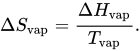
where is the heat or enthalpy of vaporization. Since this is a thermodynamic equation, the symbol refers to the absolute thermodynamic temperature, measured in kelvins (K). The entropy of vaporization is then equal to the heat of vaporization divided by the boiling point:[2][3]


According to Trouton's rule, the entropy of vaporization (at standard pressure) of most liquids has similar values. The typical value is variously given as 85 J/(mol·K),[3] 88 J/(mol·K)[4] and 90 J/(mol·K).[1] Hydrogen-bonded liquids have somewhat higher values of [4]

See also
References
- ^ a b Engel, Thomas; Reid, Philip (2006). Physical Chemistry. Pearson Benjamin Cummings. pp. 178–9. ISBN 0-8053-3842-X.
- ^ Laidler, Keith J.; Meiser, John H. (1982). Physical Chemistry. Benjamin/Cummings. p. 100. ISBN 0-8053-5682-7.
- ^ a b Atkins, Peter; de Paula, Julio (2006). Atkins' Physical Chemistry (8th ed.). United States: Oxford University Press. pp. 88–89. ISBN 0-7167-8759-8.
- ^ a b Laidler, Keith J.; Meiser, John H. (1982). Physical Chemistry. Benjamin/Cummings. pp. 176–177. ISBN 0-8053-5682-7.
 | This article about statistical mechanics is a stub. You can help Wikipedia by adding missing information. |
 | This thermodynamics-related article is a stub. You can help Wikipedia by adding missing information. |
Content Disclaimer
Informasi ini disarikan dari Wikipedia dan disajikan kembali untuk tujuan edukasi. Konten tersedia di bawah lisensi CC BY-SA 3.0. Kami tidak bertanggung jawab atas ketidakakuratan data yang bersumber dari kontribusi publik tersebut.
- The information displayed on this website is sourced in part or in whole from Wikipedia and has been adapted for the purpose of restating it. We strive to provide accurate and relevant information, however:
- There is no guarantee of absolute accuracy. Wikipedia is an open, collaborative project that can be edited by anyone, so information is subject to change.
- It is not intended to constitute professional advice. The content displayed is for informational and educational purposes only. For important decisions (e.g., medical, legal, or financial), please consult a professional.
- Content copyright. Wikipedia is licensed under the Creative Commons Attribution-ShareAlike License (CC BY-SA). This means that content may be reused with appropriate attribution and shared under a similar license.
- Responsible use. Any risk arising from the use of information from this website is entirely the responsibility of the user.