Dynamic modulus
Dynamic modulus (sometimes complex modulus[1]) is the ratio of stress to strain under vibratory conditions (calculated from data obtained from either free or forced vibration tests, in shear, compression, or elongation). It is a property of viscoelastic materials.
Viscoelastic stress–strain phase-lag
Viscoelasticity is studied using dynamic mechanical analysis where an oscillatory force (stress) is applied to a material and the resulting displacement (strain) is measured.[2]
- In purely elastic materials the stress and strain occur in phase, so that the response of one occurs simultaneously with the other.
- In purely viscous materials, there is a phase difference between stress and strain, where strain lags stress by a 90 degree ( radian) phase lag.
- Viscoelastic materials exhibit behavior somewhere in between that of purely viscous and purely elastic materials, exhibiting some phase lag in strain.[3]

Stress and strain in a viscoelastic material can be represented using the following expressions:
- Strain:
- Stress: [3]
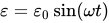

where
- where is frequency of strain oscillation,
- is time,
- is phase lag between stress and strain.


The stress relaxation modulus is the ratio of the stress remaining at time after a step strain was applied at time : ,


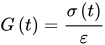
which is the time-dependent generalization of Hooke's law. For visco-elastic solids, converges to the equilibrium shear modulus[4]:

- .
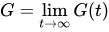
The Fourier transform of the shear relaxation modulus is (see below).


Storage and loss modulus
The storage and loss modulus in viscoelastic materials measure the stored energy, representing the elastic portion, and the energy dissipated as heat, representing the viscous portion.[3] The tensile storage and loss moduli are defined as follows:
- Storage:
- Loss: [3]
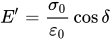
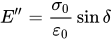
Similarly we also define shear storage and shear loss moduli, and .


Complex variables can be used to express the moduli and as follows:




where is the imaginary unit.

Ratio between loss and storage modulus
The ratio of the loss modulus to storage modulus in a viscoelastic material is defined as the , (cf. loss tangent), which provides a measure of damping in the material. can also be visualized as the tangent of the phase angle () between the storage and loss modulus.

Tensile:

Shear:

For a material with a greater than 1, the energy-dissipating, viscous component of the complex modulus prevails.
See also
References
- ^ The Open University (UK), 2000. T838 Design and Manufacture with Polymers: Solid properties and design, page 30. Milton Keynes: The Open University.
- ^ "PerkinElmer "Mechanical Properties of Films and Coatings"" (PDF). Archived from the original (PDF) on 2008-09-16. Retrieved 2009-05-09.
- ^ a b c d e Meyers and Chawla (1999): "Mechanical Behavior of Materials," 98-103.
- ^ Rubinstein, Michael, 1956 December 20- (2003). Polymer physics. Colby, Ralph H. Oxford: Oxford University Press. p. 284. ISBN 019852059X. OCLC 50339757.
{{cite book}}: CS1 maint: multiple names: authors list (link) CS1 maint: numeric names: authors list (link)
Content Disclaimer
Informasi ini disarikan dari Wikipedia dan disajikan kembali untuk tujuan edukasi. Konten tersedia di bawah lisensi CC BY-SA 3.0. Kami tidak bertanggung jawab atas ketidakakuratan data yang bersumber dari kontribusi publik tersebut.
- The information displayed on this website is sourced in part or in whole from Wikipedia and has been adapted for the purpose of restating it. We strive to provide accurate and relevant information, however:
- There is no guarantee of absolute accuracy. Wikipedia is an open, collaborative project that can be edited by anyone, so information is subject to change.
- It is not intended to constitute professional advice. The content displayed is for informational and educational purposes only. For important decisions (e.g., medical, legal, or financial), please consult a professional.
- Content copyright. Wikipedia is licensed under the Creative Commons Attribution-ShareAlike License (CC BY-SA). This means that content may be reused with appropriate attribution and shared under a similar license.
- Responsible use. Any risk arising from the use of information from this website is entirely the responsibility of the user.