Durbar Square
 | This article needs additional citations for verification. (August 2023) |


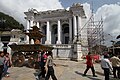
Durbar Square (from Persian دربار, darbār, meaning "court") refers to the public plazas located in front of the old royal palaces in Nepal, particularly in the Kathmandu Valley. These squares served as epicenters of political, religious, and social life during the Malla period (12th–18th centuries). The architecture of the squares reflects a rich blend of Hindu and Buddhist influences unique to Newar culture.
Each of the three main Durbar Squares—Kathmandu, Patan, and Bhaktapur—served as the royal seat of a separate Malla kingdom prior to the unification of Nepal under Prithvi Narayan Shah in the 18th century. These sites are renowned for their intricate wood carvings, multi-tiered temples, courtyards, and statuary, many of which date back several centuries.
Although the 2015 Gorkha earthquake caused significant damage to these sites, most structures have since been preserved or are under restoration, supported by both national and international efforts.[1][2]
Other Durbar
Further reading
- von Schroeder, Ulrich. 2019. Nepalese Stone Sculptures. Volume One: Hindu; Volume Two: Buddhist. (Visual Dharma Publications). ISBN 978-3-033-06381-5. Contains SD card with 15,000 digital photographs of Nepalese sculptures and other subjects as public domain.
Gallery
-
 Maju Dega-Narayana-Shiva Parvati
 -
 Pratapamalla-Jagannath
 -
 Bhimeshwara-Garuda
 -
 Maju Dega-Kamadev
 -
 Taleju
 -
 Saraswati-Chyasin Dega
 -
-
 Souvenirs
 -
 Bhagwati Temple (left), Big Bell or Taleju Bell, small Vishnu Temple (right), Kathmandu
 -
 Patan Durbar Square
 -
 Patan Durbar Square


_(cropped).jpg)


.jpg)
.jpg)
See also
References
- ^ Gutschow, Niels. The Nepalese Caitya: 1500 Years of Buddhist Votive Architecture in the Kathmandu Valley. Stuttgart: Edition Axel Menges, 1997. ISBN 9783930698801.
- ^ "Kathmandu Valley". UNESCO World Heritage Centre. Retrieved 6 August 2025.
 Media related to Durbar Square at Wikimedia Commons

27°42′17″N 85°18′27″E / 27.70472°N 85.30750°E
 | This Nepalese location article is a stub. You can help Wikipedia by adding missing information. |
Content Disclaimer
Informasi ini disarikan dari Wikipedia dan disajikan kembali untuk tujuan edukasi. Konten tersedia di bawah lisensi CC BY-SA 3.0. Kami tidak bertanggung jawab atas ketidakakuratan data yang bersumber dari kontribusi publik tersebut.
- The information displayed on this website is sourced in part or in whole from Wikipedia and has been adapted for the purpose of restating it. We strive to provide accurate and relevant information, however:
- There is no guarantee of absolute accuracy. Wikipedia is an open, collaborative project that can be edited by anyone, so information is subject to change.
- It is not intended to constitute professional advice. The content displayed is for informational and educational purposes only. For important decisions (e.g., medical, legal, or financial), please consult a professional.
- Content copyright. Wikipedia is licensed under the Creative Commons Attribution-ShareAlike License (CC BY-SA). This means that content may be reused with appropriate attribution and shared under a similar license.
- Responsible use. Any risk arising from the use of information from this website is entirely the responsibility of the user.