Double Fourier sphere method
 | This article may be too technical for most readers to understand. (August 2021) |
In mathematics, the double Fourier sphere (DFS) method is a technique that transforms a function defined on the surface of the sphere to a function defined on a rectangular domain while preserving periodicity in both the longitude and latitude directions.
Introduction
First, a function on the sphere is written as using spherical coordinates, i.e.,


![{\displaystyle f(\lambda ,\theta )=f(\cos \lambda \sin \theta ,\sin \lambda \sin \theta ,\cos \theta ),(\lambda ,\theta )\in [-\pi ,\pi ]\times [0,\pi ].}](https://wikimedia.org/api/rest_v1/media/math/render/svg/943c62468a9c362f553f76faf5960f542a27dfc2)
The function is -periodic in , but not periodic in . The periodicity in the latitude direction has been lost. To recover it, the function is "doubled up” and a related function on is defined as


![{\displaystyle [-\pi ,\pi ]\times [-\pi ,\pi ]}](https://wikimedia.org/api/rest_v1/media/math/render/svg/df436805f50de7386abdb2a9d058672ec1b4cebb)
![{\displaystyle {\tilde {f}}(\lambda ,\theta )={\begin{cases}g(\lambda +\pi ,\theta ),&(\lambda ,\theta )\in [-\pi ,0]\times [0,\pi ],\\h(\lambda ,\theta ),&(\lambda ,\theta )\in [0,\pi ]\times [0,\pi ],\\g(\lambda ,-\theta ),&(\lambda ,\theta )\in [0,\pi ]\times [-\pi ,0],\\h(\lambda +\pi ,-\theta ),&(\lambda ,\theta )\in [-\pi ,0]\times [-\pi ,0],\\\end{cases}}}](https://wikimedia.org/api/rest_v1/media/math/render/svg/ac7c8ce23921906a494e2dc05bdea5ced98d4396)
where and for . The new function is -periodic in and , and is constant along the lines and , corresponding to the poles.


![{\displaystyle (\lambda ,\theta )\in [0,\pi ]\times [0,\pi ]}](https://wikimedia.org/api/rest_v1/media/math/render/svg/718c9cd4b5a0ca50fc03fbd67cba9a024a8a5e77)


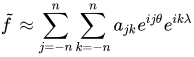
The function can be expanded into a double Fourier series
History
The DFS method was proposed by Merilees[1] and developed further by Steven Orszag.[2] The DFS method has been the subject of relatively few investigations since (a notable exception is Fornberg's work),[3] perhaps due to the dominance of spherical harmonics expansions. Over the last fifteen years it has begun to be used for the computation of gravitational fields near black holes[4] and to novel space-time spectral analysis.[5]
References
- ^ P. E. Merilees, The pseudospectral approximation applied to the shallow water equations on a sphere, Atmosphere, 11 (1973), pp. 13–20
- ^ S. A. Orszag, Fourier series on spheres, Mon. Wea. Rev., 102 (1974), pp. 56–75.
- ^ B. Fornberg, A pseudospectral approach for polar and spherical geometries, SIAM J. Sci. Comp, 16 (1995), pp. 1071–1081
- ^ R. Bartnik and A. Norton, Numerical methods for the Einstein equations in null quasispherical coordinates, SIAM J. Sci. Comp, 22 (2000), pp. 917–950
- ^ C. Sun, J. Li, F.-F. Jin, and F. Xie, Contrasting meridional structures of stratospheric and tropospheric planetary wave variability in the northern hemisphere, Tellus A, 66 (2014)
.jpg) | This black hole-related article is a stub. You can help Wikipedia by adding missing information. |
Content Disclaimer
Informasi ini disarikan dari Wikipedia dan disajikan kembali untuk tujuan edukasi. Konten tersedia di bawah lisensi CC BY-SA 3.0. Kami tidak bertanggung jawab atas ketidakakuratan data yang bersumber dari kontribusi publik tersebut.
- The information displayed on this website is sourced in part or in whole from Wikipedia and has been adapted for the purpose of restating it. We strive to provide accurate and relevant information, however:
- There is no guarantee of absolute accuracy. Wikipedia is an open, collaborative project that can be edited by anyone, so information is subject to change.
- It is not intended to constitute professional advice. The content displayed is for informational and educational purposes only. For important decisions (e.g., medical, legal, or financial), please consult a professional.
- Content copyright. Wikipedia is licensed under the Creative Commons Attribution-ShareAlike License (CC BY-SA). This means that content may be reused with appropriate attribution and shared under a similar license.
- Responsible use. Any risk arising from the use of information from this website is entirely the responsibility of the user.