Delta operator
In mathematics, a delta operator is a shift-equivariant linear operator on the vector space of polynomials in a variable over a field that reduces degrees by one.
![{\displaystyle Q\colon \mathbb {K} [x]\longrightarrow \mathbb {K} [x]}](https://wikimedia.org/api/rest_v1/media/math/render/svg/b9125feb50c9e608f806a77605e8c8fdb2ba8bf2)


To say that is shift-equivariant means that if , then



In other words, if is a "shift" of , then is also a shift of , and has the same "shifting vector" .


To say that an operator reduces degree by one means that if is a polynomial of degree , then is either a polynomial of degree , or, in case , is 0.


Sometimes a delta operator is defined to be a shift-equivariant linear transformation on polynomials in that maps to a nonzero constant. Seemingly weaker than the definition given above, this latter characterization can be shown to be equivalent to the stated definition when has characteristic zero, since shift-equivariance is a fairly strong condition.
Examples
- The forward difference operator

- is a delta operator.
- Differentiation with respect to x, written as D, is also a delta operator.
- Any operator of the form
- (where Dn(ƒ) = ƒ(n) is the nth derivative) with is a delta operator. It can be shown that all delta operators can be written in this form. For example, the difference operator given above can be expanded as


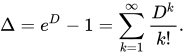
- The generalized derivative of time scale calculus which unifies the forward difference operator with the derivative of standard calculus is a delta operator.
- In computer science and cybernetics, the term "discrete-time delta operator" (δ) is generally taken to mean a difference operator
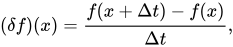
- the Euler approximation of the usual derivative with a discrete sample time . The delta-formulation obtains a significant number of numerical advantages compared to the shift-operator at fast sampling.

Basic polynomials
Every delta operator has a unique sequence of "basic polynomials", a polynomial sequence defined by three conditions:



Such a sequence of basic polynomials is always of binomial type, and it can be shown that no other sequences of binomial type exist. If the first two conditions above are dropped, then the third condition says this polynomial sequence is a Sheffer sequence—a more general concept.
See also
References
- Nikol'Skii, Nikolai Kapitonovich (1986), Treatise on the shift operator: spectral function theory, Berlin, New York: Springer-Verlag, ISBN 978-0-387-15021-5
External links
Content Disclaimer
Informasi ini disarikan dari Wikipedia dan disajikan kembali untuk tujuan edukasi. Konten tersedia di bawah lisensi CC BY-SA 3.0. Kami tidak bertanggung jawab atas ketidakakuratan data yang bersumber dari kontribusi publik tersebut.
- The information displayed on this website is sourced in part or in whole from Wikipedia and has been adapted for the purpose of restating it. We strive to provide accurate and relevant information, however:
- There is no guarantee of absolute accuracy. Wikipedia is an open, collaborative project that can be edited by anyone, so information is subject to change.
- It is not intended to constitute professional advice. The content displayed is for informational and educational purposes only. For important decisions (e.g., medical, legal, or financial), please consult a professional.
- Content copyright. Wikipedia is licensed under the Creative Commons Attribution-ShareAlike License (CC BY-SA). This means that content may be reused with appropriate attribution and shared under a similar license.
- Responsible use. Any risk arising from the use of information from this website is entirely the responsibility of the user.