Degree diameter problem
 | This article includes a list of references, related reading, or external links, but its sources remain unclear because it lacks inline citations. (November 2024) |

In graph theory, the degree diameter problem is the problem of finding the largest possible graph G (in terms of the size of its vertex set V) of diameter k such that the largest degree of any of the vertices in G is at most d. The size of G is bounded above by the Moore bound; for 1 < k and 2 < d, only the Petersen graph, the Hoffman-Singleton graph, and possibly graphs (not yet proven to exist) of diameter k = 2 and degree d = 57 attain the Moore bound. In general, the largest degree-diameter graphs are much smaller in size than the Moore bound.
Formula
Let be the maximum possible number of vertices for a graph with degree at most d and diameter k. Then , where is the Moore bound:


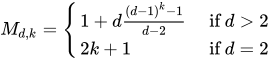
This bound is attained for very few graphs, thus the study moves to how close there exist graphs to the Moore bound. For asymptotic behaviour note that .

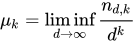
Define the parameter . It is conjectured that for all k. It is known that and that .



See also
- Cage (graph theory)
- Table of the largest known graphs of a given diameter and maximal degree
- Table of vertex-symmetric degree diameter digraphs
- Maximum degree-and-diameter-bounded subgraph problem
References
- Bannai, E.; Ito, T. (1973), "On Moore graphs", J. Fac. Sci. Univ. Tokyo Ser. A, 20: 191–208, MR 0323615
- Hoffman, Alan J.; Singleton, Robert R. (1960), "Moore graphs with diameter 2 and 3" (PDF), IBM Journal of Research and Development, 5 (4): 497–504, doi:10.1147/rd.45.0497, MR 0140437
- Singleton, Robert R. (1968), "There is no irregular Moore graph", American Mathematical Monthly, 75 (1), Mathematical Association of America: 42–43, doi:10.2307/2315106, JSTOR 2315106, MR 0225679
- Miller, Mirka; Širáň, Jozef (2005), "Moore graphs and beyond: A survey of the degree/diameter problem", Electronic Journal of Combinatorics, Dynamic survey: DS14
- CombinatoricsWiki - The Degree/Diameter Problem
 | This hyperbolic geometry-related article is a stub. You can help Wikipedia by adding missing information. |
 | This graph theory-related article is a stub. You can help Wikipedia by adding missing information. |
Content Disclaimer
Informasi ini disarikan dari Wikipedia dan disajikan kembali untuk tujuan edukasi. Konten tersedia di bawah lisensi CC BY-SA 3.0. Kami tidak bertanggung jawab atas ketidakakuratan data yang bersumber dari kontribusi publik tersebut.
- The information displayed on this website is sourced in part or in whole from Wikipedia and has been adapted for the purpose of restating it. We strive to provide accurate and relevant information, however:
- There is no guarantee of absolute accuracy. Wikipedia is an open, collaborative project that can be edited by anyone, so information is subject to change.
- It is not intended to constitute professional advice. The content displayed is for informational and educational purposes only. For important decisions (e.g., medical, legal, or financial), please consult a professional.
- Content copyright. Wikipedia is licensed under the Creative Commons Attribution-ShareAlike License (CC BY-SA). This means that content may be reused with appropriate attribution and shared under a similar license.
- Responsible use. Any risk arising from the use of information from this website is entirely the responsibility of the user.