Dawson function
_in_the_complex_plane_from_-2-2i_to_2%2B2i_with_colors_created_with_Mathematica_13.1_function_ComplexPlot3D.svg)
In mathematics, the Dawson function or Dawson integral[1] (named after H. G. Dawson[2]) is the one-sided Fourier–Laplace sine transform of the Gaussian function.
Definition




The Dawson function is defined as either: also denoted as or or alternatively
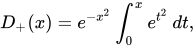


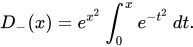
The Dawson function is the one-sided Fourier–Laplace sine transform of the Gaussian function,

It is closely related to the error function erf, as

where erfi is the imaginary error function, erfi(x) = −i erf(ix).
Similarly,
in terms of the real error function, erf.
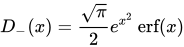
In terms of either erfi or the Faddeeva function the Dawson function can be extended to the entire complex plane:[3] which simplifies to for real

![{\displaystyle F(z)={{\sqrt {\pi }} \over 2}e^{-z^{2}}\operatorname {erfi} (z)={\frac {i{\sqrt {\pi }}}{2}}\left[e^{-z^{2}}-w(z)\right],}](https://wikimedia.org/api/rest_v1/media/math/render/svg/5e4707739a168d777d1f57cd944ce6872c9fd4c1)
![{\displaystyle D_{+}(x)=F(x)={\frac {\sqrt {\pi }}{2}}\operatorname {Im} [w(x)]}](https://wikimedia.org/api/rest_v1/media/math/render/svg/5263fe3be9abf87a3afe139c5b8c41e809fce58f)
![{\displaystyle D_{-}(x)=iF(-ix)=-{\frac {\sqrt {\pi }}{2}}\left[e^{x^{2}}-w(-ix)\right]}](https://wikimedia.org/api/rest_v1/media/math/render/svg/bc7a357d8241fa43ece147f1a877841d56529118)

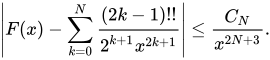
For near zero, F(x) ≈ x. For large, F(x) ≈ 1/(2x). More specifically, near the origin it has the series expansion while for large it has the asymptotic expansion




More precisely where is the double factorial.

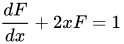
satisfies the differential equation with the initial condition Consequently, it has extrema for resulting in x = ±0.92413887... (OEIS: A133841), F(x) = ±0.54104422... (OEIS: A133842).


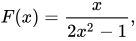
Inflection points follow for resulting in x = ±1.50197526... (OEIS: A133843), F(x) = ±0.42768661... (OEIS: A245262). (Apart from the trivial inflection point at )


Relation to Hilbert transform of Gaussian
The Hilbert transform of the Gaussian is defined as
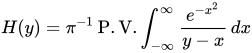
P.V. denotes the Cauchy principal value, and we restrict ourselves to real can be related to the Dawson function as follows. Inside a principal value integral, we can treat as a generalized function or distribution, and use the Fourier representation



With we use the exponential representation of and complete the square with respect to to find


![{\displaystyle \pi H(y)=\operatorname {Im} \int _{0}^{\infty }dk\,\exp[-k^{2}/4+iky]\int _{-\infty }^{\infty }dx\,\exp[-(x+ik/2)^{2}].}](https://wikimedia.org/api/rest_v1/media/math/render/svg/12890dc8ea10fe76bb211d705dbc25275718737d)
We can shift the integral over to the real axis, and it gives Thus

![{\displaystyle \pi ^{1/2}H(y)=\operatorname {Im} \int _{0}^{\infty }dk\,\exp[-k^{2}/4+iky].}](https://wikimedia.org/api/rest_v1/media/math/render/svg/1616202e4a1cd74e86616183e3e4a845aec1cc02)
We complete the square with respect to and obtain

![{\displaystyle \pi ^{1/2}H(y)=e^{-y^{2}}\operatorname {Im} \int _{0}^{\infty }dk\,\exp[-(k/2-iy)^{2}].}](https://wikimedia.org/api/rest_v1/media/math/render/svg/28fb5c23b8ffaa8bf82e0b03e78cc572c0b94305)
We change variables to
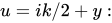

The integral can be performed as a contour integral around a rectangle in the complex plane. Taking the imaginary part of the result gives where is the Dawson function as defined above.


The Hilbert transform of is also related to the Dawson function. We see this with the technique of differentiating inside the integral sign. Let

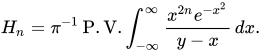
Introduce
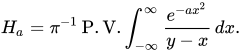
The th derivative is


We thus find
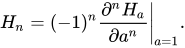
The derivatives are performed first, then the result evaluated at A change of variable also gives Since we can write where and are polynomials. For example, Alternatively, can be calculated using the recurrence relation (for )










See also
References
- ^ Temme, N. M. (2010), "Error Functions, Dawson's and Fresnel Integrals", in Olver, Frank W. J.; Lozier, Daniel M.; Boisvert, Ronald F.; Clark, Charles W. (eds.), NIST Handbook of Mathematical Functions, Cambridge University Press, ISBN 978-0-521-19225-5, MR 2723248.
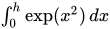
- ^ Dawson, H. G. (1897). "On the Numerical Value of ". Proceedings of the London Mathematical Society. s1-29 (1): 519–522. doi:10.1112/plms/s1-29.1.519.
- ^ Mofreh R. Zaghloul and Ahmed N. Ali, "Algorithm 916: Computing the Faddeyeva and Voigt Functions," ACM Trans. Math. Soft. 38 (2), 15 (2011). Preprint available at arXiv:1106.0151.
External links
- gsl_sf_dawson in the GNU Scientific Library
- libcerf, numeric C library for complex error functions, provides a function voigt(x, sigma, gamma) with approximately 13–14 digits precision. It is based on the Faddeeva function as implemented in the MIT Faddeeva Package
- Dawson's Integral (at Mathworld)
- Error functions Archived 2019-11-01 at the Wayback Machine
Content Disclaimer
Informasi ini disarikan dari Wikipedia dan disajikan kembali untuk tujuan edukasi. Konten tersedia di bawah lisensi CC BY-SA 3.0. Kami tidak bertanggung jawab atas ketidakakuratan data yang bersumber dari kontribusi publik tersebut.
- The information displayed on this website is sourced in part or in whole from Wikipedia and has been adapted for the purpose of restating it. We strive to provide accurate and relevant information, however:
- There is no guarantee of absolute accuracy. Wikipedia is an open, collaborative project that can be edited by anyone, so information is subject to change.
- It is not intended to constitute professional advice. The content displayed is for informational and educational purposes only. For important decisions (e.g., medical, legal, or financial), please consult a professional.
- Content copyright. Wikipedia is licensed under the Creative Commons Attribution-ShareAlike License (CC BY-SA). This means that content may be reused with appropriate attribution and shared under a similar license.
- Responsible use. Any risk arising from the use of information from this website is entirely the responsibility of the user.