Cymbalaria
| Cymbalaria | |
|---|---|

| |
| Cymbalaria muralis (ivy-leaved toadflax) | |
Scientific classification 
| |
| Kingdom: | Plantae |
| Clade: | Embryophytes |
| Clade: | Tracheophytes |
| Clade: | Spermatophytes |
| Clade: | Angiosperms |
| Clade: | Eudicots |
| Clade: | Asterids |
| Order: | Lamiales |
| Family: | Plantaginaceae |
| Tribe: | Antirrhineae |
| Genus: | Cymbalaria Hill[1][2] |
Cymbalaria is a genus of about 10 species of herbaceous perennial plants previously placed in the family Scrophulariaceae, but recently shown by genetic research to be in the much enlarged family Plantaginaceae.[citation needed]
The genus is native to southern Europe. It is closely related to the genera Linaria and Antirrhinum, differing in having creeping growth and flowers borne singly rather than in dense erect spikes. The common name toadflax is shared with Linaria and other related genera. The scientific name means "resembling a cymbal" for the somewhat rounded leaves.
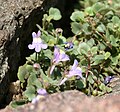
By far the best known species is Cymbalaria muralis (also called ivy-leaved toadflax, and Kenilworth ivy), native to southwest Europe. It has widely naturalised elsewhere and is commonly sold as a garden plant. C. muralis characteristically grows in sheltered crevices in walls and pathways, or in rocks and scree, making a trailing or scrambling plant up to 1 m long.
Species list
Accepted species are:[3]
- Cymbalaria aequitriloba (Viv.) A.Chev.
- Cymbalaria bakhtiarica Podlech & Iranshahr
- Cymbalaria glutinosa Bigazzi & Raffaelli
- Cymbalaria hepaticifolia (Poir.) Wettst.
- Cymbalaria longipes (Boiss. & Heldr.) A.Chev.
- Cymbalaria microcalyx (Boiss.) Wettst.
- Cymbalaria muelleri (Moris) A.Chev.
- Cymbalaria muralis G.Gaertn., B.Mey. & Schreb.
- Cymbalaria pallida (Ten.) Wettst.
- Cymbalaria pluttula (Rech.f.) Speta
- Cymbalaria pubescens (J.Presl & C.Presl) Cufod.
Taxonomy
Described as Cymbalaria by the English botanist, John Hill in 1756.[1][2]
Gallery
-

-
-

-
 Cymbalaria
 -
 Cymbalaria sp.
.jpg)


References
- ^ a b "IPNI: Cymbalaria". International Plant Name Index. Retrieved 28 May 2018.
- ^ a b Hill, J. 1756. Brit. Herb. 113; cited in Druce in The Botanical Exchange Club of the British Isles Report for 1913, iii. 437.
- ^ Govaerts, R. et al. 2018. "Plants of the World online: Cymbalaria". Board of Trustees of the Royal Botanic Gardens, Kew. Retrieved 28 May 2018.

Content Disclaimer
Informasi ini disarikan dari Wikipedia dan disajikan kembali untuk tujuan edukasi. Konten tersedia di bawah lisensi CC BY-SA 3.0. Kami tidak bertanggung jawab atas ketidakakuratan data yang bersumber dari kontribusi publik tersebut.
- The information displayed on this website is sourced in part or in whole from Wikipedia and has been adapted for the purpose of restating it. We strive to provide accurate and relevant information, however:
- There is no guarantee of absolute accuracy. Wikipedia is an open, collaborative project that can be edited by anyone, so information is subject to change.
- It is not intended to constitute professional advice. The content displayed is for informational and educational purposes only. For important decisions (e.g., medical, legal, or financial), please consult a professional.
- Content copyright. Wikipedia is licensed under the Creative Commons Attribution-ShareAlike License (CC BY-SA). This means that content may be reused with appropriate attribution and shared under a similar license.
- Responsible use. Any risk arising from the use of information from this website is entirely the responsibility of the user.