Cryptodendrum
| Cryptodendrum | |
|---|---|

| |
| C. adhaesium showing the distinctive edge tentacles | |
Scientific classification 
| |
| Kingdom: | Animalia |
| Phylum: | Cnidaria |
| Subphylum: | Anthozoa |
| Class: | Hexacorallia |
| Order: | Actiniaria |
| Family: | Thalassianthidae |
| Genus: | Cryptodendrum Klunzinger, 1877 |
| Species: | C. adhaesivum
|
| Binomial name | |
| Cryptodendrum adhaesivum (Klunzinger, 1877)
| |
| Synonyms | |
|
(Genus)
(Species)
| |
Cryptodendrum is a genus of sea anemones in the family Thalassianthidae. It is monotypic with a single species, Cryptodendrum adhaesivum, also commonly known as the adhesive anemone, pizza anemone, and nap-edged anemone. Like all symbiotic anemones it hosts zooxanthellae, symbiotic algae that help feed their host.[1]
Description
This anemone grows to a size of 30 centimeters and is distinguished by its colored, beaded and waving curved edge. It has two different forms of tentacles. At the center of the oral disc, it has narrow, short, about 5 mm long, tentacles that are branched with five or more "fingers", like a small, inflated rubber glove. The tentacles are extremely sticky. The tentacles at the edge have a bubble-like thickening of about one millimeter diameter at the end. The two types of tentacles are usually different colors.[2]
Similar species
The two different tentacles and pizza crust type edge distinguish C. adhaesivum from superficially similar Stichodactyla specimens.
Distribution
C. adhaesivum is widely distributed being found in tropical waters from the Indian Ocean to the Western Pacific.
Symbionts
The relationship between anemonefish and their host sea anemones is highly nested in structure. This anemone however is able to survive without anemonefish and most specimens are found without anemonefish.[3] As the single hosted anemonefish, Amphiprion clarkii,[2] is the extreme generalist, it may be that C. adhaesivum is a marginal host tolerated only by the least selective fish and only when no other host is available.
C. adhaesivum is also associated with juvenile Dascyllus trimaculatus the threespot dascyllus.
A number of other species are associated with C. adhaesivum, however the relationship is commensal rather than mutual as the anemone does not appear to benefit from the association. These species are
- Neopetrolisthes maculatus a porcelain crab
- Shrimp from the Periclimenes genus
- Thor amboinensis the squat or sexy shrimp
Gallery
C. adhaesivum and symbionts
-
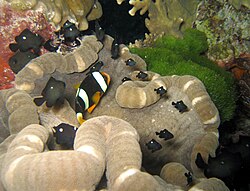 Amphiprion clarkii & Dascyllus trimaculatus
 -
 Neopetrolisthes maculatus (porcelain crab)


References
- ^ "Cryptodendrum adhaesivum at World Register of Marine Species".
- ^ a b Fautin, Daphne G.; Allen, Gerald R. (1997). Field Guide to Anemone Fishes and Their Host Sea Anemones. Western Australian Museum. ISBN 9780730983651. Archived from the original on 14 April 2015.
- ^ Ollerton J; McCollin D; Fautin DG; Allen GR (2007). "Finding NEMO: nestedness engendered by mutualistic organization in anemonefish and their hosts". Proc R Soc B Biol Sci. 274 (1609): 591–598. doi:10.1098/rspb.2006.3758. PMC 1766375. PMID 17476781.
External links


Content Disclaimer
Informasi ini disarikan dari Wikipedia dan disajikan kembali untuk tujuan edukasi. Konten tersedia di bawah lisensi CC BY-SA 3.0. Kami tidak bertanggung jawab atas ketidakakuratan data yang bersumber dari kontribusi publik tersebut.
- The information displayed on this website is sourced in part or in whole from Wikipedia and has been adapted for the purpose of restating it. We strive to provide accurate and relevant information, however:
- There is no guarantee of absolute accuracy. Wikipedia is an open, collaborative project that can be edited by anyone, so information is subject to change.
- It is not intended to constitute professional advice. The content displayed is for informational and educational purposes only. For important decisions (e.g., medical, legal, or financial), please consult a professional.
- Content copyright. Wikipedia is licensed under the Creative Commons Attribution-ShareAlike License (CC BY-SA). This means that content may be reused with appropriate attribution and shared under a similar license.
- Responsible use. Any risk arising from the use of information from this website is entirely the responsibility of the user.