Cooling flow
A cooling flow occurs when the intracluster medium (ICM) in the centres of galaxy clusters should be rapidly cooling at the rate of tens to thousands of solar masses per year.[1] This should happen as the ICM (a plasma) is quickly losing its energy by the emission of X-rays. The X-ray brightness of the ICM is proportional to the square of its density, which rises steeply towards the centres of many clusters. Also the temperature falls to typically a third or a half of the temperature in the outskirts of the cluster. The typical [predicted] timescale for the ICM to cool is relatively short, less than a billion years. As material in the centre of the cluster cools out, the pressure of the overlying ICM should cause more material to flow inwards (the cooling flow).
In a steady state, the rate of mass deposition, i.e. the rate at which the plasma cools, is given by
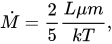
where L is the bolometric (i.e. over the entire spectrum) luminosity of the cooling region, T is its temperature, k is the Boltzmann constant and μm is the mean molecular mass.
Cooling flow problem
It is currently thought that the very large amounts of expected cooling are in reality much smaller, as there is little evidence for cool X-ray emitting gas in many of these systems.[2] This is the cooling flow problem. Theories for why there is little evidence of cooling include[3]
- Heating by the central Active galactic nucleus (AGN) in clusters, possibly via sound waves (seen in the Perseus Cluster and Virgo Cluster)
- Thermal conduction of heat from the outer parts of clusters
- Cosmic ray heating
- Hiding cool gas by absorbing material
- Mixing of cool gas with hotter material
Heating by AGN is the most popular explanation, as they emit a lot of energy over their lifetimes, and some of the alternatives listed have theoretical problems.
References
- ^ Fabian, A. C. (1994). "Cooling flows in clusters of galaxies". Annu. Rev. Astron. Astrophys. 32: 277–318. Bibcode:1994ARA&A..32..277F. doi:10.1146/annurev.aa.32.090194.001425.
- ^ Peterson, J. R.; Kahn, S. M.; Paerels, F. B. S.; Kaastra, J. S.; Tamura, T.; Bleeker, J. A. M.; Ferrigno, C.; Jernigan, J. G. (2003-06-10). "High-Resolution X-Ray Spectroscopic Constraints on Cooling-Flow Models for Clusters of Galaxies". The Astrophysical Journal. 590 (1): 207–224. arXiv:astro-ph/0210662. Bibcode:2003ApJ...590..207P. doi:10.1086/374830. ISSN 0004-637X. S2CID 18000290.
- ^ Peterson, J.R.; Fabian, A.C. (2006). "X-ray spectroscopy of cooling clusters". Physics Reports. 427 (1): 1–39. arXiv:astro-ph/0512549. Bibcode:2006PhR...427....1P. doi:10.1016/j.physrep.2005.12.007. ISSN 0370-1573. S2CID 11711221.
Further reading
- Qin, Bo; Wu, Xiang-Ping (2001-07-19). "Constraints on the Interaction between Dark Matter and Baryons from Cooling Flow Clusters". Physical Review Letters. 87 (6) 061301. arXiv:astro-ph/0106458. Bibcode:2001PhRvL..87f1301Q. doi:10.1103/physrevlett.87.061301. ISSN 0031-9007. PMID 11497819. S2CID 13510283.
- Chuzhoy, Leonid; Nusser, Adi (2006-07-10). "Consequences of Short-Range Interactions between Dark Matter and Protons in Galaxy Clusters". The Astrophysical Journal. 645 (2): 950–954. arXiv:astro-ph/0408184. Bibcode:2006ApJ...645..950C. doi:10.1086/504505. ISSN 0004-637X. S2CID 16131656.
- 5.7. Cooling flows and accretion by cDs (in X-ray Emission from Clusters of Galaxies. Sarazin 1988)
Content Disclaimer
Informasi ini disarikan dari Wikipedia dan disajikan kembali untuk tujuan edukasi. Konten tersedia di bawah lisensi CC BY-SA 3.0. Kami tidak bertanggung jawab atas ketidakakuratan data yang bersumber dari kontribusi publik tersebut.
- The information displayed on this website is sourced in part or in whole from Wikipedia and has been adapted for the purpose of restating it. We strive to provide accurate and relevant information, however:
- There is no guarantee of absolute accuracy. Wikipedia is an open, collaborative project that can be edited by anyone, so information is subject to change.
- It is not intended to constitute professional advice. The content displayed is for informational and educational purposes only. For important decisions (e.g., medical, legal, or financial), please consult a professional.
- Content copyright. Wikipedia is licensed under the Creative Commons Attribution-ShareAlike License (CC BY-SA). This means that content may be reused with appropriate attribution and shared under a similar license.
- Responsible use. Any risk arising from the use of information from this website is entirely the responsibility of the user.