Convex position
In discrete and computational geometry, a set of points in the Euclidean plane or a higher-dimensional Euclidean space is said to be in convex position or convex independent if none of the points can be represented as a convex combination of the others.[1] A finite set of points is in convex position if all of the points are vertices of their convex hull.[1] More generally, a family of convex sets is said to be in convex position if they are pairwise disjoint and none of them is contained in the convex hull of the others.[2]
An assumption of convex position can make certain computational problems easier to solve. For instance, the traveling salesman problem, NP-hard for arbitrary sets of points in the plane, is trivial for points in convex position: the optimal tour is the convex hull.[3] Similarly, the minimum-weight triangulation of planar point sets is NP-hard for arbitrary point sets,[4] but solvable in polynomial time by dynamic programming for points in convex position.[5]
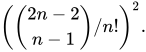
The Erdős–Szekeres theorem guarantees that every set of points in general position (no three in a line) in two or more dimensions has at least a logarithmic number of points in convex position.[6] If points are chosen uniformly at random in a unit square, the probability that they are in convex position is[7]

The McMullen problem asks for the maximum number such that every set of points in general position in a -dimensional projective space has a projective transformation to a set in convex position. Known bounds are .[8]



References
- ^ a b Matoušek, Jiří (2002), Lectures on Discrete Geometry, Graduate Texts in Mathematics, Springer-Verlag, p. 30, ISBN 978-0-387-95373-1
- ^ Tóth, Géza; Valtr, Pavel (2005), "The Erdős-Szekeres theorem: upper bounds and related results", Combinatorial and computational geometry, Math. Sci. Res. Inst. Publ., vol. 52, Cambridge: Cambridge Univ. Press, pp. 557–568, MR 2178339
- ^ Deĭneko, Vladimir G.; Hoffmann, Michael; Okamoto, Yoshio; Woeginger, Gerhard J. (2006), "The traveling salesman problem with few inner points", Operations Research Letters, 34 (1): 106–110, doi:10.1016/j.orl.2005.01.002, MR 2186082
- ^ Mulzer, Wolfgang; Rote, Günter (2008), "Minimum-weight triangulation is NP-hard", Journal of the ACM, 55 (2), Article A11, arXiv:cs.CG/0601002, doi:10.1145/1346330.1346336
- ^ Klincsek, G. T. (1980), "Minimal triangulations of polygonal domains", Annals of Discrete Mathematics, 9: 121–123, doi:10.1016/s0167-5060(08)70044-x, ISBN 9780444861115
{{citation}}: CS1 maint: work parameter with ISBN (link) - ^ Erdős, Paul; Szekeres, George (1935), "A combinatorial problem in geometry", Compositio Mathematica, 2: 463–470
- ^ Valtr, P. (1995), "Probability that n random points are in convex position", Discrete & Computational Geometry, 13 (3–4): 637–643, doi:10.1007/BF02574070, MR 1318803
- ^ Forge, David; Las Vergnas, Michel; Schuchert, Peter (2001), "10 points in dimension 4 not projectively equivalent to the vertices of a convex polytope", Combinatorial geometries (Luminy, 1999), European Journal of Combinatorics, 22 (5): 705–708, doi:10.1006/eujc.2000.0490, MR 1845494
Content Disclaimer
Informasi ini disarikan dari Wikipedia dan disajikan kembali untuk tujuan edukasi. Konten tersedia di bawah lisensi CC BY-SA 3.0. Kami tidak bertanggung jawab atas ketidakakuratan data yang bersumber dari kontribusi publik tersebut.
- The information displayed on this website is sourced in part or in whole from Wikipedia and has been adapted for the purpose of restating it. We strive to provide accurate and relevant information, however:
- There is no guarantee of absolute accuracy. Wikipedia is an open, collaborative project that can be edited by anyone, so information is subject to change.
- It is not intended to constitute professional advice. The content displayed is for informational and educational purposes only. For important decisions (e.g., medical, legal, or financial), please consult a professional.
- Content copyright. Wikipedia is licensed under the Creative Commons Attribution-ShareAlike License (CC BY-SA). This means that content may be reused with appropriate attribution and shared under a similar license.
- Responsible use. Any risk arising from the use of information from this website is entirely the responsibility of the user.