Conus purus
 | This article cites Wikipedia (or sources that take information from Wikipedia) in a circular manner. (April 2024) |
| Conus purus | |
|---|---|

| |
| Apertural and abapertural views of shell of Conus purus Tucker, Tenorio & Chaney, 2011 | |

| |
Scientific classification 
| |
| Kingdom: | Animalia |
| Phylum: | Mollusca |
| Class: | Gastropoda |
| Subclass: | Caenogastropoda |
| Order: | Neogastropoda |
| Superfamily: | Conoidea |
| Family: | Conidae |
| Genus: | Conus |
| Species: | C. purus
|
| Binomial name | |
| Conus purus Pease, 1863
| |
| Synonyms[1] | |
| |
Conus purus is a species of sea snail, a marine gastropod mollusk in the family Conidae, the cone snails, cone shells or cones.[1]
These snails are predatory and venomous. They are capable of stinging humans.
Description
The size of the shell varies between 44 and 68 mm (1.7 and 2.7 in). Conus purus is white with a tented pattern tinged with reddish brown. The spire of the shell can range from flat to conical. Each individual cone shell has a different shell form, color, and pattern.[2] The spire of the cone comes to spire or a point.[3] Additionally, the animal has brown mottling and is tan, with distinct black, white, and red tips on the siphon.[2]
Behavior
Cone snails possess venom that is so strong that it may rapidly paralyze and ultimately kill victims.[4] Conus purus venom is a complicated mixture of substances that blocks various neuromuscular pathways, ultimately resulting in paralysis.[4] It is estimated that the number of bioactive chemicals in each snail's venom is over 100,000. The development of a potent antitoxin has been hampered by the venom's intricacy and the several target routes.[4]
Unlike most cones, juveniles settle where they hatch.[2]
It feeds on other mollusks.[3]
Distribution
This marine species is endemic to Hawaii.[1] The cone inhabits shallow water, no deeper than 15 ft (4.6 m).[2]
Gallery
-
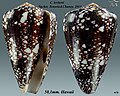 Conus purus Tucker, Tenorio & Chaney, 2011
 -
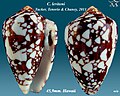 Conus purus Tucker, Tenorio & Chaney, 2011
 -
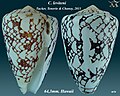 Conus purus Tucker, Tenorio & Chaney, 2011


References
- ^ a b c WoRMS. "Conus purus Pease, 1863". World Register of Marine Species. Retrieved 7 February 2024.
- ^ a b c d "Hawaiian Penniform Cone, Conus (Darioconus) purus". www.marinelifephotography.com. Retrieved 2024-03-21.
- ^ a b Kay, E. Alison (1979). Hawaiian marine shells. Reef and shore fauna of Hawaii. Honolulu, Hawaii: Bishop Museum Press. ISBN 978-0-910240-26-0.
- ^ a b c "Conus purus Cone Snail". www.reeflex.net. Retrieved 2024-03-21.[circular reference]
Further reading
- Tucker J.K., Tenorio M.J. & Chaney H.W. (2011) A revision of the status of several conoid taxa from the Hawaiian Islands: Description of Darioconus levieni n. sp., Pionoconus striatus oahuensis n. ssp. and Harmoniconus paukstisi n. sp. (Gastropoda, Conidae). In: Severns M., Shells of the Hawaiian Islands - The Sea Shells: 501-514. Conchbooks, Hackenheim.
- Tucker J.K. & Tenorio M.J. (2013) Illustrated catalog of the living cone shells. 517 pp. Wellington, Florida: MdM Publishing.
External links
- Jiménez-Tenorio, A Revision of the Status of Several Conoid Taxa from the Hawaiian Islands
- Sowerby, G. B. III. (1874). Descriptions of twelve new species of shells. Proceedings of the Zoological Society of London. 1873: 718–722, pl. 59.
- Kiener, L.C. (1844-1850). Spécies général et iconographie des coquilles vivantes. Vol. 2. Famille des Enroulées. Genre Cone (Conus, Lin.), pp. 1-379, pl. 1-111 [pp. 1-48 (1846); 49-160 (1847); 161-192 (1848); 193-240 (1849); 241-[379 (assumed to be 1850); plates 4,6 (1844); 2-3, 5, 7-32, 34-36, 38, 40-50 (1845); 33, 37, 39, 51-52, 54-56, 57-68, 74-77 (1846); 1, 69-73, 78-103 (1847); 104-106 (1848); 107 (1849); 108-111 (1850)]. Paris, Rousseau & J.B. Baillière]
- Johnson R.I. (1994). Types of shelled Indo-Pacific mollusks described by William Harper Pease. Bulletin of the Museum of Comparative Zoology. 154(1): 1-61
- Puillandre N., Duda T.F., Meyer C., Olivera B.M. & Bouchet P. (2015). One, four or 100 genera? A new classification of the cone snails. Journal of Molluscan Studies. 81: 1-23
- Pease, W. H. (1863). Description of new species of marine shells from the Pacific Islands. Proceedings of the Zoological Society of London. (1862): 278-280, pl. 11
- "Darioconus leviteni". Gastropods.com. Retrieved 16 January 2019.

 | This Conus-related article is a stub. You can help Wikipedia by adding missing information. |
Content Disclaimer
Informasi ini disarikan dari Wikipedia dan disajikan kembali untuk tujuan edukasi. Konten tersedia di bawah lisensi CC BY-SA 3.0. Kami tidak bertanggung jawab atas ketidakakuratan data yang bersumber dari kontribusi publik tersebut.
- The information displayed on this website is sourced in part or in whole from Wikipedia and has been adapted for the purpose of restating it. We strive to provide accurate and relevant information, however:
- There is no guarantee of absolute accuracy. Wikipedia is an open, collaborative project that can be edited by anyone, so information is subject to change.
- It is not intended to constitute professional advice. The content displayed is for informational and educational purposes only. For important decisions (e.g., medical, legal, or financial), please consult a professional.
- Content copyright. Wikipedia is licensed under the Creative Commons Attribution-ShareAlike License (CC BY-SA). This means that content may be reused with appropriate attribution and shared under a similar license.
- Responsible use. Any risk arising from the use of information from this website is entirely the responsibility of the user.