Conserved current
 | This article includes a list of references, related reading, or external links, but its sources remain unclear because it lacks inline citations. (December 2009) |
In physics a conserved current is a current, , that satisfies the continuity equation . The continuity equation represents a conservation law, hence the name.


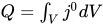
Indeed, integrating the continuity equation over a volume , large enough to have no net currents through its surface, leads to the conservation lawwhere is the conserved quantity.


In gauge theories the gauge fields couple to conserved currents. For example, the electromagnetic field couples to the conserved electric current.
Conserved quantities and symmetries
Conserved current is the flow of the canonical conjugate of a quantity possessing a continuous translational symmetry. The continuity equation for the conserved current is a statement of a conservation law. Examples of canonical conjugate quantities are:
- Time and energy - the continuous translational symmetry of time implies the conservation of energy
- Space and momentum - the continuous translational symmetry of space implies the conservation of momentum
- Space and angular momentum - the continuous rotational symmetry of space implies the conservation of angular momentum
- Wave function phase and electric charge - the continuous phase angle symmetry of the wave function implies the conservation of electric charge
Conserved currents play an extremely important role in theoretical physics, because Noether's theorem connects the existence of a conserved current to the existence of a symmetry of some quantity in the system under study. In practical terms, all conserved currents are the Noether currents, as the existence of a conserved current implies the existence of a symmetry. Conserved currents play an important role in the theory of partial differential equations, as the existence of a conserved current points to the existence of constants of motion, which are required to define a foliation and thus an integrable system. The conservation law is expressed as the vanishing of a 4-divergence, where the Noether charge forms the zeroth component of the 4-current.
Examples
Electromagnetism
The conservation of charge, for example, in the notation of Maxwell's equations,

where
- ρ is the free electric charge density (in units of C/m3)
- J is the current density with v as the velocity of the charges.

The equation would apply equally to masses (or other conserved quantities), where the word mass is substituted for the words electric charge above.
Complex scalar field
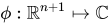
The Klein-Gordon Lagrangian density of a complex scalar field is invariant under the symmetry transformation Defining we find the Noether current which satisfies the continuity equation. Here is the generator of the symmetry, which is in the case of a single parameter .




See also
References
- Goldstein, Herbert (1980). Classical Mechanics (2nd ed.). Reading, MA: Addison-Wesley. pp. 588–596. ISBN 0-201-02918-9.
- David J Griffiths (1999). Introduction to electrodynamics (Third ed.). Prentice Hall. pp. 356–357. ISBN 978-0-13-805326-0.
- Peskin, Michael E.; Schroeder, Daniel V. (1995). "Chapter I.2.2. Elements of Classical Field Theory". An Introduction to Quantum Field Theory. CRC Press. ISBN 978-0-201-50397-5.
Content Disclaimer
Informasi ini disarikan dari Wikipedia dan disajikan kembali untuk tujuan edukasi. Konten tersedia di bawah lisensi CC BY-SA 3.0. Kami tidak bertanggung jawab atas ketidakakuratan data yang bersumber dari kontribusi publik tersebut.
- The information displayed on this website is sourced in part or in whole from Wikipedia and has been adapted for the purpose of restating it. We strive to provide accurate and relevant information, however:
- There is no guarantee of absolute accuracy. Wikipedia is an open, collaborative project that can be edited by anyone, so information is subject to change.
- It is not intended to constitute professional advice. The content displayed is for informational and educational purposes only. For important decisions (e.g., medical, legal, or financial), please consult a professional.
- Content copyright. Wikipedia is licensed under the Creative Commons Attribution-ShareAlike License (CC BY-SA). This means that content may be reused with appropriate attribution and shared under a similar license.
- Responsible use. Any risk arising from the use of information from this website is entirely the responsibility of the user.