Conformally flat manifold

A (pseudo-)Riemannian manifold is conformally flat if each point has a neighborhood that can be mapped to flat space by a conformal transformation.
In practice, the metric tensor of the manifold has to be conformal to the flat metric tensor , i.e., the geodesics maintain in all points of the angles by moving from one to the other, as well as keeping the null geodesics unchanged,[1] that means there exists a function such that , where is known as the conformal factor and is a point on the manifold.


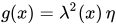

More formally, let be a pseudo-Riemannian manifold. Then is conformally flat if for each point in , there exists a neighborhood of and a smooth function defined on such that is flat (i.e. the curvature of vanishes on ). The function need not be defined on all of .


Some authors use the definition of locally conformally flat when referred to just some point on and reserve the definition of conformally flat for the case in which the relation is valid for all on .
Examples
- Every manifold with constant sectional curvature is conformally flat.
- Every 2-dimensional pseudo-Riemannian manifold is conformally flat.[1]
- The line element of the two dimensional spherical coordinates, like the one used in the geographic coordinate system, ,[2] has metric tensor and is not flat but with the stereographic projection can be mapped to a flat space using the conformal factor , where is the distance from the origin of the flat space,[3] obtaining .
- A 3-dimensional pseudo-Riemannian manifold is conformally flat if and only if the Cotton tensor vanishes.
- An n-dimensional pseudo-Riemannian manifold for n ≥ 4 is conformally flat if and only if the Weyl tensor vanishes.
- Every compact, simply connected, conformally Euclidean Riemannian manifold is conformally equivalent to the round sphere.[4]

![{\displaystyle \textstyle g_{ik}=\left[{\begin{smallmatrix}1&0\\0&\sin ^{2}\theta \end{smallmatrix}}\right]}](https://wikimedia.org/api/rest_v1/media/math/render/svg/e93d845778de7acf55ad36f2ae47cdaa881da826)


- The stereographic projection provides a coordinate system for the sphere in which conformal flatness is explicit, as the metric is proportional to the flat one.
- In general relativity, conformally flat manifolds are often used, for instance, in describing the Friedmann–Lemaître–Robertson–Walker metric.[5] However, this is not always possible, as in the case of the Kerr metric, which does not admit any conformally flat slices.[6][further explanation needed]
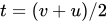
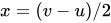
- An example of conformally flat metric can be obtained by transforming the Kruskal–Szekeres coordinates for the Schwarzschild metric, which have line element with metric tensor and so is not flat. But with the transformations and becomes with metric tensor , which is the flat metric times the conformal factor .[7]

![{\displaystyle \textstyle g_{ik}=\left[{\begin{smallmatrix}0&1-{2GM}/{r}\\1-{2GM}/{r}&0\end{smallmatrix}}\right]}](https://wikimedia.org/api/rest_v1/media/math/render/svg/1897057a56a157d00b711bf6e8bf6c26067429f9)

![{\displaystyle \textstyle g_{ik}=\left[{\begin{smallmatrix}1-{2GM}/{r}&0\\0&-1+{2GM}/{r}\end{smallmatrix}}\right]}](https://wikimedia.org/api/rest_v1/media/math/render/svg/d99d20deade49e8a2dc42920e716d98094d16a50)

See also
References
- ^ a b Ray D'Inverno. "6.13 The Weyl tensor". Introducing Einstein's Relativity. pp. 88–89.
- ^ See Spherical coordinate system § Integration and differentiation in spherical coordinates
- ^ See Stereographic projection § Properties – Riemann's formula
- ^ Kuiper, N. H. (1949). "On conformally flat spaces in the large". Annals of Mathematics. 50 (4): 916–924. doi:10.2307/1969587. JSTOR 1969587.
- ^ Garecki, Janusz (2008). "On Energy of the Friedman Universes in Conformally Flat Coordinates". Acta Physica Polonica B. 39 (4): 781–797. arXiv:0708.2783. Bibcode:2008AcPPB..39..781G.
- ^ Garat, Alcides; Price, Richard H. (2000-05-18). "Nonexistence of conformally flat slices of the Kerr spacetime". Physical Review D. 61 (12) 124011. arXiv:gr-qc/0002013. Bibcode:2000PhRvD..61l4011G. doi:10.1103/PhysRevD.61.124011. ISSN 0556-2821. S2CID 119452751.
- ^ Ray D'Inverno. "17.2 The Kruskal solution". Introducing Einstein's Relativity. pp. 230–231.
 | This Riemannian geometry-related article is a stub. You can help Wikipedia by adding missing information. |
Content Disclaimer
Informasi ini disarikan dari Wikipedia dan disajikan kembali untuk tujuan edukasi. Konten tersedia di bawah lisensi CC BY-SA 3.0. Kami tidak bertanggung jawab atas ketidakakuratan data yang bersumber dari kontribusi publik tersebut.
- The information displayed on this website is sourced in part or in whole from Wikipedia and has been adapted for the purpose of restating it. We strive to provide accurate and relevant information, however:
- There is no guarantee of absolute accuracy. Wikipedia is an open, collaborative project that can be edited by anyone, so information is subject to change.
- It is not intended to constitute professional advice. The content displayed is for informational and educational purposes only. For important decisions (e.g., medical, legal, or financial), please consult a professional.
- Content copyright. Wikipedia is licensed under the Creative Commons Attribution-ShareAlike License (CC BY-SA). This means that content may be reused with appropriate attribution and shared under a similar license.
- Responsible use. Any risk arising from the use of information from this website is entirely the responsibility of the user.