Conditional short-circuit current
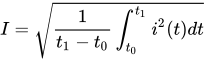
Conditional short-circuit current is the value of the alternating current component of a prospective current, which a switch without integral short-circuit protection, but protected by a suitable short circuit protective device (SCPD) in series, can withstand for the operating time of the current under specified test conditions. It may be understood to be the RMS value of the maximum permissible current over a specified time interval (t0,t1) and operating conditions. The IEC[1] definition is critiqued to be open to interpretation.[2]
References
- ^ IEC 62314-1, The International Standard on Solid-State Relays, Ed 1, Section 3.1.11
- ^ Gurevich, Vladimir (2011). Digital protective relays: problems and solutions. Boca Raton: CRC Press. p. 360. ISBN 978-1-4398-3785-6.
 | This electronics-related article is a stub. You can help Wikipedia by adding missing information. |
Content Disclaimer
Informasi ini disarikan dari Wikipedia dan disajikan kembali untuk tujuan edukasi. Konten tersedia di bawah lisensi CC BY-SA 3.0. Kami tidak bertanggung jawab atas ketidakakuratan data yang bersumber dari kontribusi publik tersebut.
- The information displayed on this website is sourced in part or in whole from Wikipedia and has been adapted for the purpose of restating it. We strive to provide accurate and relevant information, however:
- There is no guarantee of absolute accuracy. Wikipedia is an open, collaborative project that can be edited by anyone, so information is subject to change.
- It is not intended to constitute professional advice. The content displayed is for informational and educational purposes only. For important decisions (e.g., medical, legal, or financial), please consult a professional.
- Content copyright. Wikipedia is licensed under the Creative Commons Attribution-ShareAlike License (CC BY-SA). This means that content may be reused with appropriate attribution and shared under a similar license.
- Responsible use. Any risk arising from the use of information from this website is entirely the responsibility of the user.