This article needs attention from an expert in Mathematics. The specific problem is: Convert mathematical proof into readable prose that is useful to readers onwiki.WikiProject Mathematics may be able to help recruit an expert.(November 2023)
Let the dynamics of the controlled robot be described by
where is the state vector of joint variables that describe the system, is the inertia matrix, is the vector Coriolis and centrifugal torques, are the torques caused by gravity and is the vector of joint torque inputs.
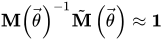
Assume that we have an approximate model of the system made up of . This model does not need to be perfect, but it should justify the approximations and .
Given a desired trajectory the error relative to the current state is then .
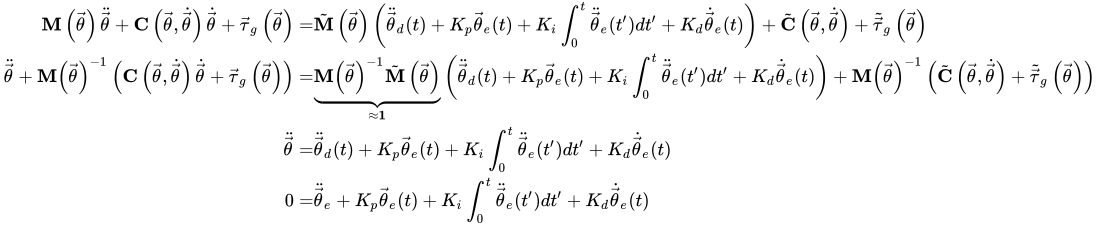
We can then set the input of the system to be
With this input the dynamics of the entire systems becomes
and the normal methods for PID controller tuning can be applied. In this way the complicated nonlinear control problem has been reduced to a relatively simple linear control problem.
References
^Lynch, Kevin M.; Park, Frank C. (2017). Modern robotics: mechanics, planning, and control. Cambridge: Cambridge university press. ISBN978-1-107-15630-2.
^Siciliano, Bruno; Khatib, Oussama, eds. (2016). Springer handbook of robotics. Springer handbooks (2nd ed.). Berlin Heidelberg: Springer. pp. 174–175. ISBN978-3-319-32550-7.
Content Disclaimer
Informasi ini disarikan dari Wikipedia dan disajikan kembali untuk tujuan edukasi. Konten tersedia di bawah lisensi CC BY-SA 3.0. Kami tidak bertanggung jawab atas ketidakakuratan data yang bersumber dari kontribusi publik tersebut.
The information displayed on this website is sourced in part or in whole from Wikipedia and has been adapted for the purpose of restating it. We strive to provide accurate and relevant information, however:
There is no guarantee of absolute accuracy. Wikipedia is an open, collaborative project that can be edited by anyone, so information is subject to change.
It is not intended to constitute professional advice. The content displayed is for informational and educational purposes only. For important decisions (e.g., medical, legal, or financial), please consult a professional.
Content copyright. Wikipedia is licensed under the Creative Commons Attribution-ShareAlike License (CC BY-SA). This means that content may be reused with appropriate attribution and shared under a similar license.
Responsible use. Any risk arising from the use of information from this website is entirely the responsibility of the user.