Comparison function
In applied mathematics, comparison functions are several classes of continuous functions, which are used in stability theory to characterize the stability properties of control systems as Lyapunov stability, uniform asymptotic stability etc.
Let be a space of continuous functions acting from to . The most important classes of comparison functions are:


![{\displaystyle {\begin{aligned}{\mathcal {P}}&:=\left\{\gamma \in C({\mathbb {R} }_{+},{\mathbb {R} }_{+}):\gamma (0)=0{\text{ and }}\gamma (r)>0{\text{ for }}r>0\right\}\\[4pt]{\mathcal {K}}&:=\left\{\gamma \in {\mathcal {P}}:\gamma {\text{ is strictly increasing}}\right\}\\[4pt]{\mathcal {K}}_{\infty }&:=\left\{\gamma \in {\mathcal {K}}:\gamma {\text{ is unbounded}}\right\}\\[4pt]{\mathcal {L}}&:=\{\gamma \in C({\mathbb {R} }_{+},{\mathbb {R} }_{+}):\gamma {\text{ is strictly decreasing with }}\lim _{t\rightarrow \infty }\gamma (t)=0\}\\[4pt]{\mathcal {KL}}&:=\left\{\beta \in C({\mathbb {R} }_{+}\times {\mathbb {R} }_{+},{\mathbb {R} }_{+}):\beta {\text{ is continuous, }}\beta (\cdot ,t)\in {\mathcal {K}},\ \forall t\geq 0,\ \beta (r,\cdot )\in {\mathcal {L}},\ \forall r>0\right\}\end{aligned}}}](https://wikimedia.org/api/rest_v1/media/math/render/svg/d44a1a03f7ca4b8c6aea4bee22597463a7bd843f)
Functions of class are also called positive-definite functions.

One of the most important properties of comparison functions is given by Sontag’s -Lemma,[1] named after Eduardo Sontag. It says that for each and any there exist :



|
| 1 |

Many further useful properties of comparison functions can be found in.[2][3]
Comparison functions are primarily used to obtain quantitative restatements of stability properties as Lyapunov stability, uniform asymptotic stability, etc. These restatements are often more useful than the qualitative definitions of stability properties given in language.

As an example, consider an ordinary differential equation
|
| 2 |

where is locally Lipschitz. Then:
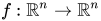
- (2) is globally stable if and only if there is a so that for any initial condition and for any it holds that


|
| 3 |

- (2) is globally asymptotically stable if and only if there is a so that for any initial condition and for any it holds that
|
| 4 |

The comparison-functions formalism is widely used in input-to-state stability theory.
References
Content Disclaimer
Informasi ini disarikan dari Wikipedia dan disajikan kembali untuk tujuan edukasi. Konten tersedia di bawah lisensi CC BY-SA 3.0. Kami tidak bertanggung jawab atas ketidakakuratan data yang bersumber dari kontribusi publik tersebut.
- The information displayed on this website is sourced in part or in whole from Wikipedia and has been adapted for the purpose of restating it. We strive to provide accurate and relevant information, however:
- There is no guarantee of absolute accuracy. Wikipedia is an open, collaborative project that can be edited by anyone, so information is subject to change.
- It is not intended to constitute professional advice. The content displayed is for informational and educational purposes only. For important decisions (e.g., medical, legal, or financial), please consult a professional.
- Content copyright. Wikipedia is licensed under the Creative Commons Attribution-ShareAlike License (CC BY-SA). This means that content may be reused with appropriate attribution and shared under a similar license.
- Responsible use. Any risk arising from the use of information from this website is entirely the responsibility of the user.