Coleman–Weinberg potential
The Coleman–Weinberg model represents quantum electrodynamics of a scalar field in four-dimensions. The Lagrangian for the model is

where the scalar field is complex, is the electromagnetic field tensor, and the covariant derivative containing the electric charge of the electromagnetic field.



Assume that is nonnegative. Then if the mass term is tachyonic, there is a spontaneous breaking of the gauge symmetry at low energies, a variant of the Higgs mechanism. On the other hand, if the squared mass is positive, the vacuum expectation of the field is zero. At the classical level the latter is true also if . However, as was shown by Sidney Coleman and Erick Weinberg, even if the renormalized mass is zero, spontaneous symmetry breaking still happens due to the radiative corrections (this introduces a mass scale into a classically conformal theory - the model has a conformal anomaly).


The same can happen in other gauge theories. In the broken phase the fluctuations of the scalar field will manifest themselves as a naturally light Higgs boson, as a matter of fact even too light to explain the electroweak symmetry breaking in the minimal model - much lighter than vector bosons. There are non-minimal models that give a more realistic scenarios. Also the variations of this mechanism were proposed for the hypothetical spontaneously broken symmetries including supersymmetry.
Equivalently one may say that the model possesses a first-order phase transition as a function of . The model is the four-dimensional analog of the three-dimensional Ginzburg–Landau theory used to explain the properties of superconductors near the phase transition.

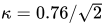
The three-dimensional version of the Coleman–Weinberg model governs the superconducting phase transition which can be both first- and second-order, depending on the ratio of the Ginzburg–Landau parameter , with a tricritical point near which separates type I from type II superconductivity. Historically, the order of the superconducting phase transition was debated for a long time since the temperature interval where fluctuations are large (Ginzburg interval) is extremely small. The question was finally settled in 1982.[1] If the Ginzburg–Landau parameter that distinguishes type-I and type-II superconductors (see also here) is large enough, vortex fluctuations becomes important which drive the transition to second order. The tricritical point lies at roughly , i.e., slightly below the value where type-I goes over into type-II superconductor. The prediction was confirmed in 2002 by Monte Carlo computer simulations.[2]


Literature
- S. Coleman and E. Weinberg (1973). "Radiative Corrections as the Origin of Spontaneous Symmetry Breaking". Physical Review D. 7 (6): 1888–1910. arXiv:hep-th/0507214. Bibcode:1973PhRvD...7.1888C. doi:10.1103/PhysRevD.7.1888. S2CID 6898114.
- L.D. Landau (1937). "On the theory of phase transitions. II". Zhurnal Eksperimental'noi i Teoreticheskoi Fiziki. 7: 627.
- V.L. Ginzburg and L.D. Landau (2009). "On the Theory of Superconductivity". On Superconductivity and Superfluidity. pp. 113–137. doi:10.1007/978-3-540-68008-6_4. ISBN 978-3-540-68004-8.
- M.Tinkham (2004). Introduction to Superconductivity. Dover Books on Physics (2nd ed.). Dover. ISBN 0-486-43503-2.
See also
References
- ^ H. Kleinert (1982). "Disorder Version of the Abelian Higgs Model and the Order of the Superconductive Phase Transition" (PDF). Lettere al Nuovo Cimento. 35 (13): 405–412. doi:10.1007/BF02754760. S2CID 121012850.
- ^ J. Hove; S. Mo; A. Sudbo (2002). "Vortex interactions and thermally induced crossover from type-I to type-II superconductivity" (PDF). Phys. Rev. B 66 (6) 064524. arXiv:cond-mat/0202215. Bibcode:2002PhRvB..66f4524H. doi:10.1103/PhysRevB.66.064524. S2CID 13672575.
 | This quantum mechanics–related article is a stub. You can help Wikipedia by adding missing information. |
Content Disclaimer
Informasi ini disarikan dari Wikipedia dan disajikan kembali untuk tujuan edukasi. Konten tersedia di bawah lisensi CC BY-SA 3.0. Kami tidak bertanggung jawab atas ketidakakuratan data yang bersumber dari kontribusi publik tersebut.
- The information displayed on this website is sourced in part or in whole from Wikipedia and has been adapted for the purpose of restating it. We strive to provide accurate and relevant information, however:
- There is no guarantee of absolute accuracy. Wikipedia is an open, collaborative project that can be edited by anyone, so information is subject to change.
- It is not intended to constitute professional advice. The content displayed is for informational and educational purposes only. For important decisions (e.g., medical, legal, or financial), please consult a professional.
- Content copyright. Wikipedia is licensed under the Creative Commons Attribution-ShareAlike License (CC BY-SA). This means that content may be reused with appropriate attribution and shared under a similar license.
- Responsible use. Any risk arising from the use of information from this website is entirely the responsibility of the user.