Cocks IBE scheme
Cocks IBE scheme is an identity based encryption system proposed by Clifford Cocks in 2001.[1] The security of the scheme is based on the hardness of the quadratic residuosity problem.
Protocol
Setup
The PKG chooses:
- a public RSA-modulus , where are prime and kept secret,
- the message and the cipher space and
- a secure public hash function .




Extract
When user wants to obtain his private key, he contacts the PKG through a secure channel. The PKG

- derives with by a deterministic process from (e.g. multiple application of ),
- computes (which fulfils either or , see below) and
- transmits to the user.






Encrypt
To encrypt a bit (coded as /) for , the user


- chooses random with ,
- chooses random with , different from ,
- computes and and
- sends to the user.





Decrypt
To decrypt a ciphertext for user , he


- computes if or otherwise, and
- computes .


Note that here we are assuming that the encrypting entity does not know whether has the square root of or . In this case we have to send a ciphertext for both cases. As soon as this information is known to the encrypting entity, only one element needs to be sent.


Correctness
First note that since (i.e. ) and , either or is a quadratic residue modulo .

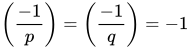
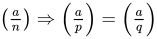


Therefore, is a square root of or :[2]

Where the last step is the result of a combination of Euler's Criterion and the Chinese remainder theorem.
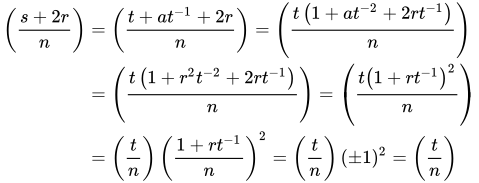
Moreover, (for the case that is a quadratic residue, same idea holds for ):
Security
It can be shown that breaking the scheme is equivalent to solving the quadratic residuosity problem, which is suspected to be very hard. The common rules for choosing a RSA modulus hold: Use a secure , make the choice of uniform and random and moreover include some authenticity checks for (otherwise, an adaptive chosen ciphertext attack can be mounted by altering packets that transmit a single bit and using the oracle to observe the effect on the decrypted bit).

Problems
A major disadvantage of this scheme is that it can encrypt messages only bit per bit - therefore, it is only suitable for small data packets like a session key. To illustrate, consider a 128 bit key that is transmitted using a 1024 bit modulus. Then, one has to send 2 × 128 × 1024 bit = 32 KByte (when it is not known whether is the square of a or −a), which is only acceptable for environments in which session keys change infrequently.
This scheme does not preserve key-privacy, i.e. a passive adversary can recover meaningful information about the identity of the recipient observing the ciphertext.
References
- ^ Clifford Cocks, An Identity Based Encryption Scheme Based on Quadratic Residues Archived 2007-02-06 at the Wayback Machine, Proceedings of the 8th IMA International Conference on Cryptography and Coding, 2001
- ^ Prager, S. (2011). The Cocks IBE Scheme: The Legendre Symbol and Quadratic Reciprocity (Undergraduate honors thesis, University of Redlands). Retrieved from https://inspire.redlands.edu/cas_honors/502
Content Disclaimer
Informasi ini disarikan dari Wikipedia dan disajikan kembali untuk tujuan edukasi. Konten tersedia di bawah lisensi CC BY-SA 3.0. Kami tidak bertanggung jawab atas ketidakakuratan data yang bersumber dari kontribusi publik tersebut.
- The information displayed on this website is sourced in part or in whole from Wikipedia and has been adapted for the purpose of restating it. We strive to provide accurate and relevant information, however:
- There is no guarantee of absolute accuracy. Wikipedia is an open, collaborative project that can be edited by anyone, so information is subject to change.
- It is not intended to constitute professional advice. The content displayed is for informational and educational purposes only. For important decisions (e.g., medical, legal, or financial), please consult a professional.
- Content copyright. Wikipedia is licensed under the Creative Commons Attribution-ShareAlike License (CC BY-SA). This means that content may be reused with appropriate attribution and shared under a similar license.
- Responsible use. Any risk arising from the use of information from this website is entirely the responsibility of the user.