Clarke's equation
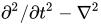
In combustion, Clarke's equation is a third-order nonlinear partial differential equation, first derived by John Frederick Clarke in 1978.[1][2][3][4] The equation describes the thermal explosion process, including both effects of constant-volume and constant-pressure processes, as well as the effects of adiabatic and isothermal sound speeds.[5] The equation reads as[6]

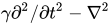
or, alternatively[7]

where is the non-dimensional temperature perturbation, is the specific heat ratio and is the relevant Damköhler number. The term describes the thermal explosion at constant pressure and the term describes the thermal explosion at constant volume. Similarly, the term describes the wave propagation at adiabatic sound speed and the term describes the wave propagation at isothermal sound speed. Molecular transports are neglected in the derivation.


It may appear that the parameter can be removed from the equation by the transformation , it is, however, retained here since may also appear in the initial and boundary conditions.

Example: Fast, non-diffusive ignition by deposition of a radially symmetric hot source
Suppose a radially symmetric hot source is deposited instantaneously in a reacting mixture. When the chemical time is comparable to the acoustic time, diffusion is neglected so that ignition is characterised by heat release by the chemical energy and cooling by the expansion waves. This problem is governed by the Clarke's equation with , where is the maximum initial temperature, is the temperature and is the Frank-Kamenetskii temperature ( is the gas constant and is the activation energy). Furthermore, let denote the distance from the center, measured in units of initial hot core size and be the time, measured in units of acoustic time. In this case, the initial and boundary conditions are given by[6]







where , respectively, corresponds to the planar, cylindrical and spherical problems. Let us define a new variable


which is the increment of from its distant values. Then, at small times, the asymptotic solution is given by


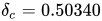
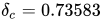
As time progresses, a steady state is approached when and a thermal explosion is found to occur when , where is the Frank-Kamenetskii parameter; if , then in the planar case, in the cylindrical case and in the spherical case. For , the solution in the first approximation is given by


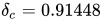


which shows that thermal explosion occurs at , where is the ignition time.


Generalised form
For generalised form for the reaction term, one may write

where is arbitrary function representing the reaction term.

See also
References
- ^ Clarke, J. F. (1978). "A progress report on the theoretical analysis of the interaction between a shock wave and an explosive gas mixture", College of Aeronautics report. 7801, Cranfield Inst. of Tech.
- ^ Clarke, J. F. (1978). Small amplitude gasdynamic disturbances in an exploding atmosphere. Journal of Fluid Mechanics, 89(2), 343–355.
- ^ Clarke, J. F. (1981), "Propagation of Gasdynamic Disturbances in an Explosive Atmosphere", in Combustion in Reactive Systems, J.R. Bowen, R.I. Soloukhin, N. Manson, and A.K. Oppenheim (Eds), Progress in Astronautics and Aeronautics, pp. 383-402.
- ^ Clarke, J. F. (1982). "Non-steady Gas Dynamic Effects in the Induction Domain Behind a Strong Shock Wave", College of Aeronautics report. 8229, Cranfield Inst. of Tech. https://repository.tudelft.nl/view/aereports/uuid%3A9c064b5f-97b4-4527-a97e-a805d5e1abd7
- ^ Bray, K. N. C.; Riley, N. (2014). "John Frederick Clarke 1 May 1927 – 11 June 2013". Biographical Memoirs of Fellows of the Royal Society. 60: 87–106. doi:10.1098/rsbm.2014.0012.
- ^ a b Vázquez-Espí, C., & Liñán, A. (2001). Fast, non-diffusive ignition of a gaseous reacting mixture subject to a point energy source. Combustion Theory and Modelling, 5(3), 485.
- ^ Kapila, A. K., and J. W. Dold. "Evolution to detonation in a nonuniformly heated reactive medium." Asymptotic Analysis and the Numerical Solution of Partial Differential Equations 130 (1991).
Content Disclaimer
Informasi ini disarikan dari Wikipedia dan disajikan kembali untuk tujuan edukasi. Konten tersedia di bawah lisensi CC BY-SA 3.0. Kami tidak bertanggung jawab atas ketidakakuratan data yang bersumber dari kontribusi publik tersebut.
- The information displayed on this website is sourced in part or in whole from Wikipedia and has been adapted for the purpose of restating it. We strive to provide accurate and relevant information, however:
- There is no guarantee of absolute accuracy. Wikipedia is an open, collaborative project that can be edited by anyone, so information is subject to change.
- It is not intended to constitute professional advice. The content displayed is for informational and educational purposes only. For important decisions (e.g., medical, legal, or financial), please consult a professional.
- Content copyright. Wikipedia is licensed under the Creative Commons Attribution-ShareAlike License (CC BY-SA). This means that content may be reused with appropriate attribution and shared under a similar license.
- Responsible use. Any risk arising from the use of information from this website is entirely the responsibility of the user.