Charles Gilbert Chaddock
Charles Gilbert Chaddock | |
|---|---|
.jpg) | |
| Born | November 14, 1861 Jonesville, Michigan, U.S. |
| Died | July 20, 1936 (aged 74) St. Louis, Missouri, U.S. |
| Education | University of Michigan College of Medicine and Surgery |
| Occupations | Neurologist, psychiatrist, translator |
| Known for | Describing the Chaddock reflex and the first use of the words bisexuality, heterosexuality, and homosexuality in the English language[1][2] |
| Signature | |
 | |
Charles Gilbert Chaddock (November 14, 1861 – July 20, 1936) was an American neurologist, psychiatrist, and translator. He is remembered for describing the Chaddock reflex and is credited with introducing the terms bisexuality, heterosexuality, and homosexuality from German into the English language.[1][2]
Biography
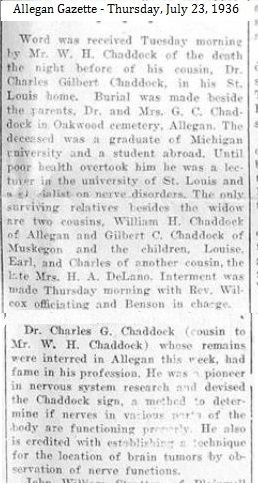
Charles Gilbert Chaddock was born on November 14, 1861, in Jonesville, Michigan.[3] In 1885, he graduated from the University of Michigan College of Medicine and Surgery, then worked at the North Michigan Asylum in Traverse City as a staff physician. From 1889 to 1890, Chaddock studied in Munich. On his return, he again worked at the Asylum, before, in 1892, becoming Professor of Nervous and Mental Diseases at Marion-Sims College, which later became part of the Saint Louis University School of Medicine. He married Adelaide Gowans MacPherson in 1890.[3] Baddock returned to Europe in 1897, spending most of the time as assistant to Joseph Babinski.[4] On his return to the United States in 1899, Chaddock introduced American physicians to Babinski's sign, later publishing a translation of Babinski's work.[5] Chaddock introduced his eponymous reflex in 1911, calling it the External Malleolar sign.[6][7] He also described an analogous sign in the upper limb.[8] Chaddock died on July 20, 1936.[3] He was interred by a Protestant reverend in Oakwood Cemetery, Allegan, Michigan.[9]
Legacy
Chaddock is credited with the first use of the words heterosexuality and homosexuality in the English language,[1] as well as the first use of the word bisexuality in its sense of being sexually attracted to both women and men,[1][2] in his translation of Richard von Krafft-Ebing's Psychopathia Sexualis in 1892.[10][11] Prior to Von Krafft-Ebing's new use of the term, "bisexual" was usually used to refer to hermaphroditic plants, that is having both male and female reproductive structures, or to refer to mixed-sex situations such as coed schools.[citation needed]
References
- ^ a b c d Nadal, Kevin L. (2017). The SAGE Encyclopedia of Psychology and Gender. Thousand Oaks, California: SAGE Publishing. ISBN 978-1-4833-8426-9. OCLC 994139871.
- ^ a b c Harper, Douglas (November 2001). "Bisexuality". Online Etymology Dictionary. Archived from the original on 26 October 2004. Retrieved 16 February 2007.
- ^ a b c O'Leary, James L.; Moore, Walter L. (1953). "Charles Gilbert Chaddock: His Life and Contributions". Journal of the History of Medicine and Allied Sciences. 8 (3): 301–317. doi:10.1093/jhmas/VIII.July.301. ISSN 0022-5045. JSTOR 24619896. PMID 13069695.
- ^ Goetz, Christopher G. (2002). "History of the Extensor Plantar Response: Babinski and Chaddock Signs". Seminars in Neurology. 22 (4): 391–398. doi:10.1055/s-2002-36761. ISSN 0271-8235. PMID 12539060.
- ^ Chaddock CG. Translation of J Babinski: tendon reflexes and bone reflexes: an authorized translation. Interstate Med J 1914;21:75-84, 178-185, 585-594, 1047-1054
- ^ Chaddock CG. A preliminary consideration concerning a new diagnostic nervous sign. Interstate Med J 1911;12:742-746
- ^ Chaddock CG. The external malleolar sign. Interstate Med J 1911;13:1026-1038
- ^ Chaddock CG. A new reflex phenomenon in the hand: the wrist-sign. Interstate Med J 1912;19:127-131
- ^ "Untitled". Allegan Gazette. 1936-07-23. Retrieved 2022-07-08.
- ^ Susan Ackerman, When Heroes Love: The Ambiguity of Eros in the Stories of Gilgamesh and David. Cambridge University Press, 2005, ISBN 0231132603, p. 5.
- ^ "Significant Gay Events ~ Timeline" (PDF). Archived from the original (PDF) on 2014-03-15. Retrieved 2014-03-15.
External links


- Works by or about Charles Gilbert Chaddock at the Internet Archive
- Works by Charles Gilbert Chaddock at Project Gutenberg
- Works by or about Charles Gilbert Chaddock at the Online Books Page
- Charles Gilbert Chaddock at Find a Grave
| International | |
|---|---|
| National | |
| Other | |

Content Disclaimer
Informasi ini disarikan dari Wikipedia dan disajikan kembali untuk tujuan edukasi. Konten tersedia di bawah lisensi CC BY-SA 3.0. Kami tidak bertanggung jawab atas ketidakakuratan data yang bersumber dari kontribusi publik tersebut.
- The information displayed on this website is sourced in part or in whole from Wikipedia and has been adapted for the purpose of restating it. We strive to provide accurate and relevant information, however:
- There is no guarantee of absolute accuracy. Wikipedia is an open, collaborative project that can be edited by anyone, so information is subject to change.
- It is not intended to constitute professional advice. The content displayed is for informational and educational purposes only. For important decisions (e.g., medical, legal, or financial), please consult a professional.
- Content copyright. Wikipedia is licensed under the Creative Commons Attribution-ShareAlike License (CC BY-SA). This means that content may be reused with appropriate attribution and shared under a similar license.
- Responsible use. Any risk arising from the use of information from this website is entirely the responsibility of the user.