Change of fiber
In algebraic topology, given a fibration p:E→B, the change of fiber is a map between the fibers induced by paths in B.
Since a covering is a fibration, the construction generalizes the corresponding facts in the theory of covering spaces.
Definition
If β is a path in B that starts at, say, b, then we have the homotopy where the first map is a projection. Since p is a fibration, by the homotopy lifting property, h lifts to a homotopy with . We have:



- .

(There might be an ambiguity and so need not be well-defined.)

Let denote the set of path classes in B. We claim that the construction determines the map:

- the set of homotopy classes of maps.

Suppose β, β' are in the same path class; thus, there is a homotopy h from β to β'. Let
- .

Drawing a picture, there is a homeomorphism that restricts to a homeomorphism . Let be such that , and .

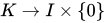



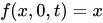
Then, by the homotopy lifting property, we can lift the homotopy to w such that w restricts to . In particular, we have , establishing the claim.



It is clear from the construction that the map is a homomorphism: if ,

![{\displaystyle \tau ([c_{b}])=\operatorname {id} ,\,\tau ([\beta ]\cdot [\gamma ])=\tau ([\beta ])\circ \tau ([\gamma ])}](https://wikimedia.org/api/rest_v1/media/math/render/svg/6186e289b4a94f4868cee734f1e7c26a839ca02c)
where is the constant path at b. It follows that has inverse. Hence, we can actually say:

![{\displaystyle \tau ([\beta ])}](https://wikimedia.org/api/rest_v1/media/math/render/svg/ece8a3de6501c15095ef321c602c8bf67b55b280)
- the set of homotopy classes of homotopy equivalences.
Also, we have: for each b in B,
- { [ƒ] | homotopy equivalence }
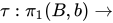

which is a group homomorphism (the right-hand side is clearly a group.) In other words, the fundamental group of B at b acts on the fiber over b, up to homotopy. This fact is a useful substitute for the absence of the structure group.
Consequence
One consequence of the construction is the below:
- The fibers of p over a path-component is homotopy equivalent to each other.
References
- James F. Davis, Paul Kirk, Lecture Notes in Algebraic Topology
- May, J. A Concise Course in Algebraic Topology
Content Disclaimer
Informasi ini disarikan dari Wikipedia dan disajikan kembali untuk tujuan edukasi. Konten tersedia di bawah lisensi CC BY-SA 3.0. Kami tidak bertanggung jawab atas ketidakakuratan data yang bersumber dari kontribusi publik tersebut.
- The information displayed on this website is sourced in part or in whole from Wikipedia and has been adapted for the purpose of restating it. We strive to provide accurate and relevant information, however:
- There is no guarantee of absolute accuracy. Wikipedia is an open, collaborative project that can be edited by anyone, so information is subject to change.
- It is not intended to constitute professional advice. The content displayed is for informational and educational purposes only. For important decisions (e.g., medical, legal, or financial), please consult a professional.
- Content copyright. Wikipedia is licensed under the Creative Commons Attribution-ShareAlike License (CC BY-SA). This means that content may be reused with appropriate attribution and shared under a similar license.
- Responsible use. Any risk arising from the use of information from this website is entirely the responsibility of the user.