Carathéodory kernel theorem
In mathematics, the Carathéodory kernel theorem is a result in complex analysis and geometric function theory established by the Greek mathematician Constantin Carathéodory in 1912. The uniform convergence on compact sets of a sequence of holomorphic univalent functions, defined on the unit disk in the complex plane and fixing 0, can be formulated purely geometrically in terms of the limiting behaviour of the images of the functions. The kernel theorem has wide application in the theory of univalent functions and in particular provides the geometric basis for the Loewner differential equation.
Kernel of a sequence of open sets
Let Un be a sequence of open sets in C containing 0. Let Vn be the connected component of the interior of Un ∩ Un + 1 ∩ ... containing 0. The kernel of the sequence is defined to be the union of the Vn's, provided it is non-empty; otherwise it is defined to be . Thus the kernel is either a connected open set containing 0 or the one point set . The sequence is said to converge to a kernel if each subsequence has the same kernel.

Examples
- If Un is an increasing sequence of connected open sets containing 0, then the kernel is just the union.
- If Un is a decreasing sequence of connected open sets containing 0, then, if 0 is an interior point of U1 ∩ U2 ∩ ..., the sequence converges to the component of the interior containing 0. Otherwise, if 0 is not an interior point, the sequence converges to .
Kernel theorem
Let fn(z) be a sequence of holomorphic univalent functions on the unit disk D, normalised so that fn(0) = 0 and f 'n (0) > 0. Then fn converges uniformly on compacts in D to a function f if and only if Un = fn(D) converges to its kernel and this kernel is not C. If the kernel is , then f = 0. Otherwise the kernel is a connected open set U, f is univalent on D and f(D) = U.
Proof
Using Hurwitz's theorem and Montel's theorem, it is straightforward to check that if fn tends uniformly on compacts to f, then each subsequence of Un has kernel U = f(D).
Conversely if Un converges to a kernel not equal to C, then by the Koebe quarter theorem Un contains the disk of radius f 'n(0) / 4 with centre 0. The assumption that U ≠ C implies that these radii are uniformly bounded. By the Koebe distortion theorem
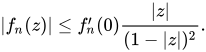
Hence the sequence fn is uniformly bounded on compact sets. If two subsequences converge to holomorphic limits f and g, then f(0) = g(0) and with f'(0), g'(0) ≥ 0. By the first part and the assumptions it follows that f(D) = g(D). Uniqueness in the Riemann mapping theorem forces f = g, so the original sequence fn is uniformly convergent on compact sets.
References
- Carathéodory, C. (1912), "Untersuchungen über die konformen Abbildungen von festen und veranderlichen Gebieten", Math. Ann., 72: 107–144, doi:10.1007/bf01456892
- Duren, P. L. (1983), Univalent functions, Grundlehren der Mathematischen Wissenschaften, vol. 259, Springer-Verlag, ISBN 0-387-90795-5
- Pommerenke, C. (1975), Univalent functions, with a chapter on quadratic differentials by Gerd Jensen, Studia Mathematica/Mathematische Lehrbücher, vol. 15, Vandenhoeck & Ruprecht
Content Disclaimer
Informasi ini disarikan dari Wikipedia dan disajikan kembali untuk tujuan edukasi. Konten tersedia di bawah lisensi CC BY-SA 3.0. Kami tidak bertanggung jawab atas ketidakakuratan data yang bersumber dari kontribusi publik tersebut.
- The information displayed on this website is sourced in part or in whole from Wikipedia and has been adapted for the purpose of restating it. We strive to provide accurate and relevant information, however:
- There is no guarantee of absolute accuracy. Wikipedia is an open, collaborative project that can be edited by anyone, so information is subject to change.
- It is not intended to constitute professional advice. The content displayed is for informational and educational purposes only. For important decisions (e.g., medical, legal, or financial), please consult a professional.
- Content copyright. Wikipedia is licensed under the Creative Commons Attribution-ShareAlike License (CC BY-SA). This means that content may be reused with appropriate attribution and shared under a similar license.
- Responsible use. Any risk arising from the use of information from this website is entirely the responsibility of the user.