Artstein's theorem
Artstein's theorem states that a nonlinear dynamical system in the control-affine form
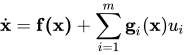
has a differentiable control-Lyapunov function if and only if it admits a regular stabilizing feedback u(x), that is a locally Lipschitz function on Rn\{0}.[1]
The original 1983 proof by Zvi Artstein proceeds by a nonconstructive argument. In 1989 Eduardo D. Sontag provided a constructive version of this theorem explicitly exhibiting the feedback.[2][3]
See also
References
- ^ Artstein, Zvi (1983). "Stabilization with relaxed controls". Nonlinear Analysis: Theory, Methods & Applications. 7 (11): 1163–1173. doi:10.1016/0362-546X(83)90049-4.
- ^ Sontag, Eduardo D. A Universal Construction Of Artstein's Theorem On Nonlinear Stabilization
- ^ Sontag, Eduardo D. (1999), "Stability and stabilization: discontinuities and the effect of disturbances", in Clarke, F. H.; Stern, R. J.; Sabidussi, G. (eds.), Nonlinear Analysis, Differential Equations and Control, Springer Netherlands, pp. 551–598, arXiv:math/9902026, doi:10.1007/978-94-011-4560-2_10, ISBN 9780792356660, S2CID 13439
 | This applied mathematics–related article is a stub. You can help Wikipedia by adding missing information. |
Content Disclaimer
Informasi ini disarikan dari Wikipedia dan disajikan kembali untuk tujuan edukasi. Konten tersedia di bawah lisensi CC BY-SA 3.0. Kami tidak bertanggung jawab atas ketidakakuratan data yang bersumber dari kontribusi publik tersebut.
- The information displayed on this website is sourced in part or in whole from Wikipedia and has been adapted for the purpose of restating it. We strive to provide accurate and relevant information, however:
- There is no guarantee of absolute accuracy. Wikipedia is an open, collaborative project that can be edited by anyone, so information is subject to change.
- It is not intended to constitute professional advice. The content displayed is for informational and educational purposes only. For important decisions (e.g., medical, legal, or financial), please consult a professional.
- Content copyright. Wikipedia is licensed under the Creative Commons Attribution-ShareAlike License (CC BY-SA). This means that content may be reused with appropriate attribution and shared under a similar license.
- Responsible use. Any risk arising from the use of information from this website is entirely the responsibility of the user.