Articular process
| Articular process | |
|---|---|
 A cervical vertebra. (Superior and inferior processes labeled at right.) | |
 A thoracic vertebra. (Superior labeled at top; inferior labeled at bottom.) | |
| Details | |
| Identifiers | |
| Latin | processus articularis inferior vertebrae, processus articularis superior vertebrae |
| FMA | 11952 |
| Anatomical terms of bone | |
The articular process or zygapophysis (Greek: ζυγόν, romanized: zugón, lit. 'yoke' + apophysis) of a vertebra is a projection of the vertebra that serves the purpose of fitting with an adjacent vertebra. The actual region of contact is called the articular facet.[1]
Articular processes spring from the junctions of the pedicles and laminæ, and there are two right and left, and two superior and inferior. These stick out of an end of a vertebra to lock with a zygapophysis on the next vertebra, to make the backbone more stable.
- The superior processes or prezygapophysis project upward from a lower vertebra, and their articular surfaces are directed more or less backward (oblique coronal plane).
- The inferior processes or postzygapophysis project downward from a higher vertebra, and their articular surfaces are directed more or less forward and outward.
The articular surfaces are coated with hyaline cartilage.
In the cervical vertebral column, the articular processes collectively form the articular pillars. These are the bony surfaces palpated just lateral to the spinous processes.
Additional images
-
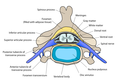 Cervical vertebra
 -
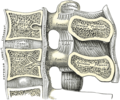 Median sagittal section of two lumbar vertebræ and their ligaments.


See also
References
 This article incorporates text in the public domain from page 97 of the 20th edition of Gray's Anatomy (1918)
- ^ Moore, Keith L. et al. (2010) Clinically Oriented Anatomy, 6th Ed, p.442 fig. 4.2
External links
- aplab[dead link] - BioWeb at University of Wisconsin System
- Articular processes[permanent dead link] - BlueLink Anatomy - University of Michigan Medical School
- Atlas image: back_bone28 at the University of Michigan Health System - "Lumbar Vertebral Column, Posterolateral View"
- Anatomy figure: 02:01-09 at Human Anatomy Online, SUNY Downstate Medical Center - "Superior and lateral views of typical vertebrae."
- Photo of model at Waynesburg College skeleton2/inferiorarticularprocess
- Photo of model at Waynesburg College skeleton2/superiorarticularprocess


 | This human musculoskeletal system article is a stub. You can help Wikipedia by adding missing information. |
Content Disclaimer
Informasi ini disarikan dari Wikipedia dan disajikan kembali untuk tujuan edukasi. Konten tersedia di bawah lisensi CC BY-SA 3.0. Kami tidak bertanggung jawab atas ketidakakuratan data yang bersumber dari kontribusi publik tersebut.
- The information displayed on this website is sourced in part or in whole from Wikipedia and has been adapted for the purpose of restating it. We strive to provide accurate and relevant information, however:
- There is no guarantee of absolute accuracy. Wikipedia is an open, collaborative project that can be edited by anyone, so information is subject to change.
- It is not intended to constitute professional advice. The content displayed is for informational and educational purposes only. For important decisions (e.g., medical, legal, or financial), please consult a professional.
- Content copyright. Wikipedia is licensed under the Creative Commons Attribution-ShareAlike License (CC BY-SA). This means that content may be reused with appropriate attribution and shared under a similar license.
- Responsible use. Any risk arising from the use of information from this website is entirely the responsibility of the user.