Arab tribes of Iraq
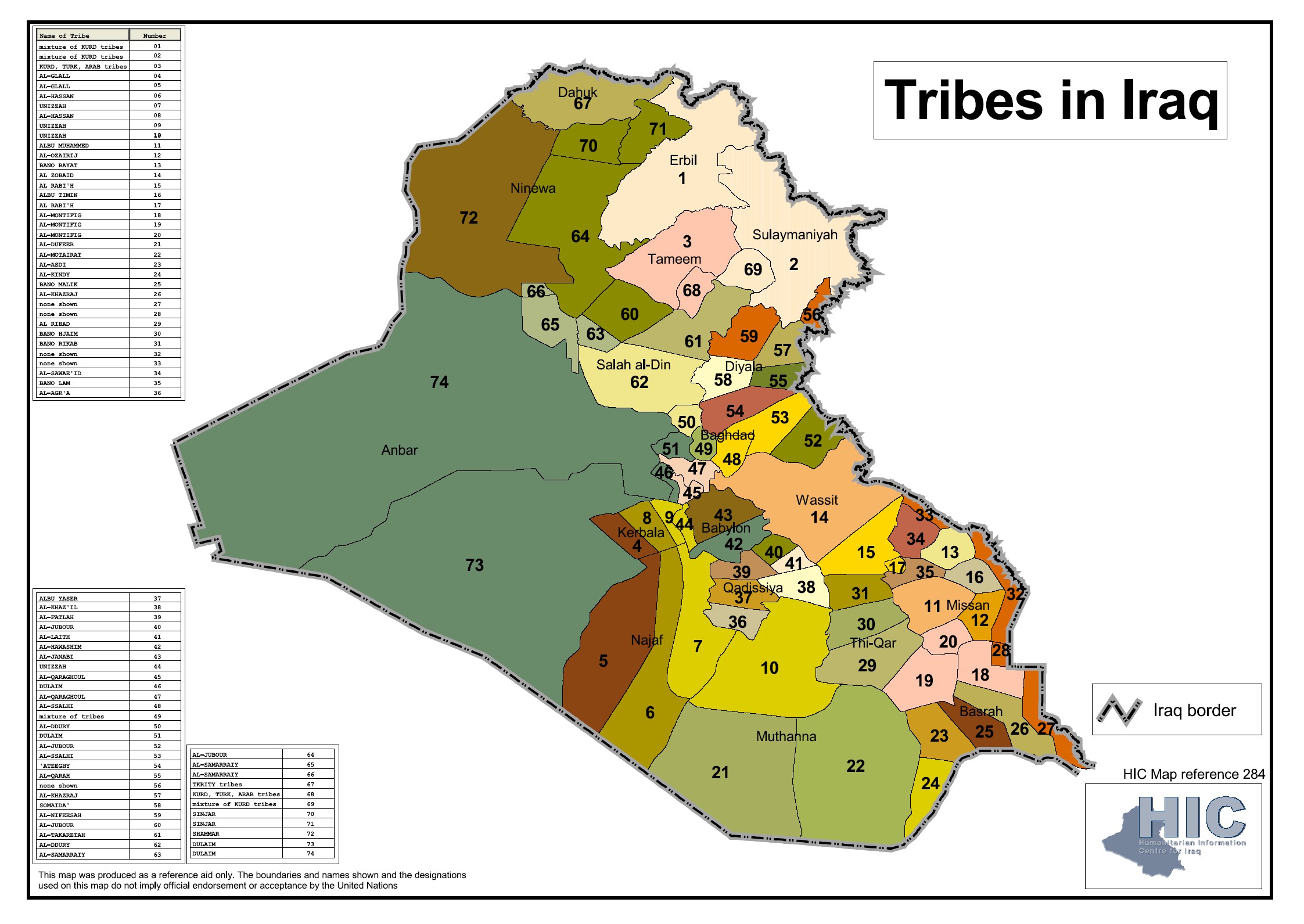
Many Iraqi Arabs identify strongly with a tribe (العشيرة 'ashira). 30 of the 150 or so identifiable tribes of Iraq are the most influential. They are grouped into federations (قبيلة qabila). Within the tribe, there is the clan (الفخذ fukhdh), the house (البيت beit) and the extended family (الخمس khams). Tribes are led by sheikhs (شيخ sheykh) who represent the tribe and deal with its domestic affairs. Due to the large sizes of Iraq's tribes, an individual may belong to the Shammar tribe, but also the Aslam branch within the same tribe, and therefore can identify with both. Many Arabs identify more strongly with their family and tribe than their national or religious affiliation. There are around 150 major tribes in Iraq, to which 75% of the total Iraqi population belong.[1]
On its accession to power in the 17 July Revolution of 1968, Iraq's Ba'ath Party announced its opposition to tribalism ( القبلية ''al-qabaliyya''), although for pragmatic reasons, especially during the Iran–Iraq War, tribalism was sometimes tolerated and even encouraged.
List of major tribes
- Al-Khafaji
- Al-Srai
- Al-Sari
- Al-Alattiya
- Al-Maliki
- Al-Qaraghoul
- Al-Khuza'ah
- Al-Shammari
- Al-Samraie
- Al-Azzawi
- Al-Huraithi
- Al-Absawi
- Al-Asooli
- Al-Dulaimi
- Al-Jubouri
- Al-Juaibar
- Al-Suwaidi
- Al-Amri
- Al-Nuaimi
- Al-Jumaili
- Al-Salaman
- Al-Naji
- Al-Kadhmi
- Al-Qarawi
- Al-Janabi
- Al-Wani
- Al-Ahmed
- Al-Kaabi
- Al-Anzi
- Al-Ubaid
- Al-Ali
- Al-Duraji
- Al-Khazail
- Al-Hasan
- Al-Khazraji
- Al-Lami
- Al-Malik
- Al-Muntafiq
- Al-Nasiri
- Al-Dhafeer
- Al-Musawi
- Al-Yasiri
- Al-Asadi
- Al-Salman
- Al-Zubaidi
- Al-Mutairi
- Al-Otaibi
- Al-Kilab
- Al-Bayati
- Al-Kaabi
- Al-Uqaydat
- Al-Bu Badri
- Al-Baggara
- Al-Rahabi
- Al-Talafha
- Al-Sawae'id
- Al-Manaseer
- Albu Badran
Partial source:[2]
See also
References
- ^ "Iraq - Country Briefing - ecoi.net". www.ecoi.net. Retrieved 2026-05-10.
- ^ "Tribes in Iraq". Humanitarian Information Centre for Iraq. 2003.
- Tripp, Charles (2000) A History of Iraq. Cambridge University Press. ISBN 0-521-55404-7/ISBN 0-521-55633-3
- Al-Azzawi, Abbas. Asha'ir al-Iraq (The Tribes of Iraq). Baghdad Press, Iraq.
- Al-Amiri, Thamir. "Mawsu'at al-Qaba'il al-Iraqiyya" (The Encyclopedia of Iraqi Tribes). 9 vols. Baghdad, 1991–1997.
- Al-Samarra'i, Younis Al-Sheikh Ibrahim. Al-Qaba'il al-Iraqiyya (Iraqi Tribes). Al-Sharaf Al-Jedid Press, Baghdad, Iraq.
- Al-Samarra'i, Younis Al-Sheikh Ibrahim. Al-Qaba'il wa al-Biyoutat al-Hashimiya fi al-Iraq (Hashimi Tribes and Families in Iraq). Al-Umma Press, Baghdad.
- Al-Durubi, Ibrahim. Al-Baghdadiyun, Akhbaruhum wa Majalisuhum (The Baghdadis, Their Annals and Assemblies). Al-Rabita Press, Baghdad, 1958.
- ath-Thuroihi, Abdul Maula. (Ar-Riyaadh al-Azhariyyah Fii Taariikh al-Usor al-‘Alawiyyah)
These prefixes ignored in the alphabetical ordering: Al, Al-Bu, Albu, Banu. | |
Part of Arab tribes |

Content Disclaimer
Informasi ini disarikan dari Wikipedia dan disajikan kembali untuk tujuan edukasi. Konten tersedia di bawah lisensi CC BY-SA 3.0. Kami tidak bertanggung jawab atas ketidakakuratan data yang bersumber dari kontribusi publik tersebut.
- The information displayed on this website is sourced in part or in whole from Wikipedia and has been adapted for the purpose of restating it. We strive to provide accurate and relevant information, however:
- There is no guarantee of absolute accuracy. Wikipedia is an open, collaborative project that can be edited by anyone, so information is subject to change.
- It is not intended to constitute professional advice. The content displayed is for informational and educational purposes only. For important decisions (e.g., medical, legal, or financial), please consult a professional.
- Content copyright. Wikipedia is licensed under the Creative Commons Attribution-ShareAlike License (CC BY-SA). This means that content may be reused with appropriate attribution and shared under a similar license.
- Responsible use. Any risk arising from the use of information from this website is entirely the responsibility of the user.