Approximate limit
In mathematics, the approximate limit is a generalization of the ordinary limit for real-valued functions of several real variables.
A function f on has an approximate limit y at a point x if there exists a set F that has density 1 at the point such that if xn is a sequence in F that converges towards x then f(xn) converges towards y.

Properties
The approximate limit of a function, if it exists, is unique. If f has an ordinary limit at x then it also has an approximate limit with the same value.
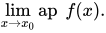
We denote the approximate limit of f at x0 by
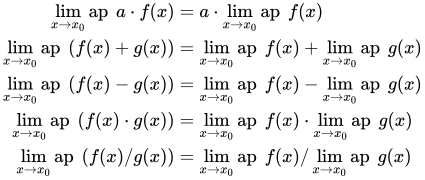
Many of the properties of the ordinary limit are also true for the approximate limit.
In particular, if a is a scalar and f and g are functions, the following equations are true if values on the right-hand side are well-defined (that is the approximate limits exist and in the last equation the approximate limit of g is non-zero.)
Approximate continuity and differentiability
If

then f is said to be approximately continuous at x0. If f is function of only one real variable and the difference quotient
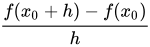
has an approximate limit as h approaches zero we say that f has an approximate derivative at x0. It turns out that approximate differentiability implies approximate continuity, in perfect analogy with ordinary continuity and differentiability.
It also turns out that the usual rules for the derivative of a sum, difference, product and quotient have straightforward generalizations to the approximate derivative. There is no generalization of the chain rule that is true in general however.
External links
- Approximate continuity at Encyclopedia of Mathematics
- Approximate derivative at Encyclopedia of Mathematics
- Approximate differentiability at Encyclopedia of Mathematics
References
- Bruckner, Andrew (1994), Differentiation of real functions (Second ed.), AMS Bookstore, ISBN 0-8218-6990-6
- Tolstov, G.P. (2001) [1994], "Approximate limit", Encyclopedia of Mathematics, EMS Press
Content Disclaimer
Informasi ini disarikan dari Wikipedia dan disajikan kembali untuk tujuan edukasi. Konten tersedia di bawah lisensi CC BY-SA 3.0. Kami tidak bertanggung jawab atas ketidakakuratan data yang bersumber dari kontribusi publik tersebut.
- The information displayed on this website is sourced in part or in whole from Wikipedia and has been adapted for the purpose of restating it. We strive to provide accurate and relevant information, however:
- There is no guarantee of absolute accuracy. Wikipedia is an open, collaborative project that can be edited by anyone, so information is subject to change.
- It is not intended to constitute professional advice. The content displayed is for informational and educational purposes only. For important decisions (e.g., medical, legal, or financial), please consult a professional.
- Content copyright. Wikipedia is licensed under the Creative Commons Attribution-ShareAlike License (CC BY-SA). This means that content may be reused with appropriate attribution and shared under a similar license.
- Responsible use. Any risk arising from the use of information from this website is entirely the responsibility of the user.