Alpha factor
The α-factor is a dimensionless quantity used to predict the solid–liquid interface type of a material during solidification. It was introduced by physicist Kenneth A. Jackson in 1958. In his model, crystal growth with larger values of α is smooth, whereas crystals growing at smaller α (below the threshold value of 2) have rough surfaces.[1][2]
Method
According to John E. Gruzleski in his book Microstructure Development During Metalcasting (1996):
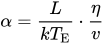
where is the latent heat of fusion; is the Boltzmann constant; is the freezing temperature at equilibrium; is the number of nearest neighbours an atom has in the interface plane; and is the number of nearest neighbours in the bulk solid.


As , where is the molar entropy of fusion of the material,


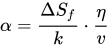
According to Martin Glicksman in his book Principles of Solidification: An Introduction to Modern Casting and Crystal Growth Concepts (2011):
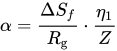
where is the universal gas constant. is similar to previous, always < 1.[4]


References
- ^ Bennema, P. (1993). "Morphology of crystals determined by alpha factors, roughening temperature, F faces and connected nets". Journal of Physics D: Applied Physics. 26 (8B): B1–B6. doi:10.1088/0022-3727/26/8b/001.
- ^ Uhlmann, Don; Fratello, Vincent (2022). "Kenneth A. Jackson (1930–2022)". National Academy of Engineering. Retrieved 2024-04-01.
- ^ Gruzleski, John E. (1996). Microstructure Development During Metalcasting.
- ^ Glicksman, Martin (2011). Principles of Solidification: An Introduction to Modern Casting and Crystal Growth Concepts.
 | This condensed matter physics-related article is a stub. You can help Wikipedia by adding missing information. |
Content Disclaimer
Informasi ini disarikan dari Wikipedia dan disajikan kembali untuk tujuan edukasi. Konten tersedia di bawah lisensi CC BY-SA 3.0. Kami tidak bertanggung jawab atas ketidakakuratan data yang bersumber dari kontribusi publik tersebut.
- The information displayed on this website is sourced in part or in whole from Wikipedia and has been adapted for the purpose of restating it. We strive to provide accurate and relevant information, however:
- There is no guarantee of absolute accuracy. Wikipedia is an open, collaborative project that can be edited by anyone, so information is subject to change.
- It is not intended to constitute professional advice. The content displayed is for informational and educational purposes only. For important decisions (e.g., medical, legal, or financial), please consult a professional.
- Content copyright. Wikipedia is licensed under the Creative Commons Attribution-ShareAlike License (CC BY-SA). This means that content may be reused with appropriate attribution and shared under a similar license.
- Responsible use. Any risk arising from the use of information from this website is entirely the responsibility of the user.