Xiphos
| Xiphos | |
|---|---|
.jpg) | |
| Angaben | |
| Waffenart: | Schwert |
| Bezeichnungen: | Xiphos[1][2] |
| Verwendung: | Militärische Waffe |
| Ursprungsregion/ Urheber: |
Griechenland |
| Verbreitung: | Griechenland |
| Gesamtlänge: | 70–75 cm |
| Klingenlänge: | 60 cm |
| Werkstoff: | Eisen, Holz |
| Griffstück: | Holz/Horn |
| Listen zum Thema | |
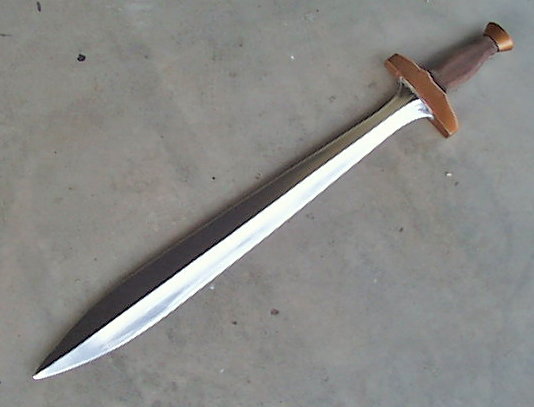
Das Xiphos (altgriechisch ξίφος xíphos, deutsch ‚Degen, Schwert‘) ist ein Schwert aus dem antiken Griechenland. Die Schneide war etwa 60 Zentimeter lang und eine Vorstufe des römischen Gladius. Das Xiphos war die Hauptwaffe griechischer Armeen neben dem Speer, insbesondere dem Xyston, und wurde nach Wurf oder Verlust des Speers eingesetzt. Das gerade, zweischneidige Schwert war sowohl als Hieb- als auch als Stichwaffe zu benutzen.[2][1]
Beschreibung
Das Xiphos hat eine zweischneidige, blattförmige Klinge. Die Klinge wird vom Heft zur Mitte hin breiter und verschmälert sich wieder zum Ort hin. Sie hat einen Mittelgrat, der über die gesamte Klinge läuft. Das Heft besteht aus Holz oder Horn. Das Xiphos wurde von griechischen Armeen benutzt. Die Klingenform ähnelt sehr stark den Gündlingen-Schwertern der Hallstatt-Kultur (Hallstattschwert).[2][1]
Literatur
- George Cameron Stone, Donald J. LaRocca: A glossary of the construction, decoration and use of arms and armor in all countries and in all times. Together with some closely related subjects. Courier Dover Publications, Mineola NY 1999, ISBN 0-486-40726-8, S. glossary of the construction.
- Richard F. Burton: Book of the Sword. Chattoo and Windus, London 1884 (Scanversion/Vollversion, englisch).
Weblinks
Einzelnachweise

Content Disclaimer
Informasi ini disarikan dari Wikipedia dan disajikan kembali untuk tujuan edukasi. Konten tersedia di bawah lisensi CC BY-SA 3.0. Kami tidak bertanggung jawab atas ketidakakuratan data yang bersumber dari kontribusi publik tersebut.
- The information displayed on this website is sourced in part or in whole from Wikipedia and has been adapted for the purpose of restating it. We strive to provide accurate and relevant information, however:
- There is no guarantee of absolute accuracy. Wikipedia is an open, collaborative project that can be edited by anyone, so information is subject to change.
- It is not intended to constitute professional advice. The content displayed is for informational and educational purposes only. For important decisions (e.g., medical, legal, or financial), please consult a professional.
- Content copyright. Wikipedia is licensed under the Creative Commons Attribution-ShareAlike License (CC BY-SA). This means that content may be reused with appropriate attribution and shared under a similar license.
- Responsible use. Any risk arising from the use of information from this website is entirely the responsibility of the user.