Shading
Shading oder Schattierung[1] ist ein Begriff aus der 3D-Computergrafik, der im weiten Sinn die Simulation der Oberflächeneigenschaften von Objekten bezeichnet.[2] Im Speziellen bezeichnet Shading die Anwendung eines Interpolationsverfahrens, mit dem der Normalenvektor auf beliebigen Punkten eines Polygonnetzes berechnet wird. Interpolative Shading-Techniken können dazu verwendet werden, um Oberflächen „glatter“ aussehen zu lassen.
Shading-Techniken
- Flat Shading (auch constant shading, faceted shading[3] oder konstante Schattierung) führt keine Interpolation durch, sondern greift auf die Farbe eines Vertex des gerade zu zeichnenden Polygons zurück. Diese Farbe wird für alle Pixel innerhalb des Polygons verwendet.
- Beim Gouraud Shading (auch intensity interpolation shading oder Color Interpolation Shading) wird die Beleuchtung auf die Vertices des Polygons angewendet, die Farbwerte der einzelnen Pixel jedoch aus den Farbwerten der Vertices interpoliert.
- Phong Shading (auch normal-vector interpolation shading) interpoliert für jedes Pixel aus den Normalen der Vertices eine interpolierte Normale des Pixels, und wendet das Beleuchtungsmodell für jedes Pixel mit einer neuen Normale an.
-
 Kugel mit lambertschem Beleuchtungsmodell und Flat Shading
 -
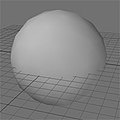 Kugel mit lambertschem Beleuchtungsmodell und Gouraud Shading


Shading im Allgemeinen
Zu Shading im weiten Sinn siehe Material (3D-Computergrafik).
Literatur
- Tomas Akenine-Möller: Real-Time Rendering, S. 70 ff. A. K. Peters, Wellesley (MA) 2002, ISBN 1-56881-182-9
- Hans-Joachim Bungartz u. a.: Einführung in die Computergrafik, S. 154–158. Vieweg, Braunschweig 2002, ISBN 3-528-16769-6
- Prof. Dieter Orlamünder, Wilfried Mascolus: Computergrafik und OpenGL: Eine systematische Einführung, S. 252ff. Carl Hanser, 2004, ISBN 3-44640-072-9
- Alan Watt: 3D Computer Graphics, S. 179–183. Pearson, Harlow 2000, ISBN 0-201-39855-9
Einzelnachweise
- ↑ Bungartz, S. 154
- ↑ Siehe etwa Watt, Kapitel 6.2 „Shading pixels“
- ↑ James D. Foley u. a.: Computer Graphics: Principles and Practice, S. 734. Addison-Wesley, Reading (MA) 1997, ISBN 0-201-84840-6
Content Disclaimer
Informasi ini disarikan dari Wikipedia dan disajikan kembali untuk tujuan edukasi. Konten tersedia di bawah lisensi CC BY-SA 3.0. Kami tidak bertanggung jawab atas ketidakakuratan data yang bersumber dari kontribusi publik tersebut.
- The information displayed on this website is sourced in part or in whole from Wikipedia and has been adapted for the purpose of restating it. We strive to provide accurate and relevant information, however:
- There is no guarantee of absolute accuracy. Wikipedia is an open, collaborative project that can be edited by anyone, so information is subject to change.
- It is not intended to constitute professional advice. The content displayed is for informational and educational purposes only. For important decisions (e.g., medical, legal, or financial), please consult a professional.
- Content copyright. Wikipedia is licensed under the Creative Commons Attribution-ShareAlike License (CC BY-SA). This means that content may be reused with appropriate attribution and shared under a similar license.
- Responsible use. Any risk arising from the use of information from this website is entirely the responsibility of the user.