Relationsalgebra

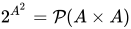
In der Mathematik und abstrakten Algebra ist eine Relationsalgebra (englisch: relation algebra) eine residuierte Boolesche Algebra,[1] die um eine Involution (als einstellige Operation), genannt Konverse, erweitert wurde. Das für diese Begriffsbildung maßgebliche Beispiel einer Relationsalgebra ist die Algebra aller zweistelligen Relationen auf einer Menge (d. h. auf den Teilmengen des kartesischen Produkts ), zusammen mit der Verkettung von Relationen und der Umkehrrelation (konversen Relation).


Definition
Die folgenden Axiome sind angelehnt an Givant (2006, Seite 283) und wurden zuerst 1948 von Alfred Tarski aufgestellt.[2]
Eine Relationsalgebra ist ein 9-Tupel , für das gilt:

- ist eine Boolesche Algebra mit Konjunktion , Disjunktion und Negation sowie Nullelement und Einselement :
- ist ein Monoid mit einem eigenen Einselement ,
- ist eine Involution, genannt Konverse,
- , d. h. die Konverse ist gegenüber der Verknüpfung treu,
- ,
- (Distributivität) und
- , was nichts anderes bedeutet als (Peircesches Gesetz).[3]

Veranschaulichung zum Peirceschen Gesetz, hier mit u, v, w statt a, b, c










Beispiel
Die homogenen zweistelligen Relationen bilden die Relationsalgebra


unter Verwendung der Notationen .[5]

Peirce-Algebra
- Eine Weiterentwicklung davon ist die (heterogene) Peirce-Algebra, benannt nach Charles Sanders Peirce – eine abstrakte Beschreibung der Relationsalgebra der homogenen zweistelligen Relationen zusammen mit Vor-/Nachbeschränkungen auf Mengen.

Siehe auch
Einzelnachweise und Bemerkungen
- ↑ eine Boolesche Algebra, deren Verbandsstruktur ein residuierter Verband ist (englisch: residuated Algebra), siehe: Marcel Erné: Algebraische Verbandstheorie, Institut für Algebra, Zahlentheorie und Diskrete Mathematik, Leibniz Universität Hannover
- ↑ Alfred Tarski (1948) "Abstract: Representation Problems for Relation Algebras," Bulletin of the AMS 54: 80.
- ↑ Chris Brink et al. Seite 12
- ↑ Nach Robin Hirsch, Ian Hodkinson: Relation algebras Seite 7, auf: Third Indian Conference on Logic and its Applications (ICLA), 7.–11. Januar 2009, Chennai, India. Das Tupel wurde an die obige Definition angeglichen.
- ↑ Von den Verknüpfungen (einstellig), sowie (zweistellig) sind - genau genommen - die Einschränkungen auf bzw. gemeint.


Literatur
- Rudolf Carnap: Introduction to Symbolic Logic and its Applications. Dover Publications, 1958.
- Steven Givant: The calculus of relations as a foundation for mathematics. In: Journal of Automated Reasoning. Band 37, 2006, S. 277–322, doi:10.1007/s10817-006-9062-x.
- P. R. Halmos: Naive Set Theory. Van Nostrand, 1960.
- Leon Henkin, Alfred Tarski, J. D. Monk: Cylindric Algebras. Part 1, 1971, und Part 2, 1985, North Holland.
- R. Hirsch, I. Hodkinson: Relation Algebra by Games. (= Studies in Logic and the Foundations of Mathematics. vol. 147). Elsevier Science, 2002, ISBN 0-444-50932-1.
- Bjarni Jónsson, Constantine Tsinakis: Relation algebras as residuated Boolean algebras. In: Algebra Universalis. Band 30, 1993, S. 469–478, doi:10.1007/BF01195378.
- Roger Maddux: The Origin of Relation Algebras in the Development and Axiomatization of the Calculus of Relations. In: Studia Logica. Band 50, Nr. 3–4, 1991, S. 421–455, doi:10.1007/BF00370681 (iastate.edu [PDF]).
- Roger D Maddux: Relation Algebras. (= Studies in Logic and the Foundations of Mathematics. Vol. 150). Elsevier Science, 2006, ISBN 1-280-64163-0.
- Patrick Suppes: Axiomatic Set Theory. Van Nostrand. Dover 1972, Chapter 3.
- Gunther Schmidt: Relational Mathematics. Cambridge University Press, 2010.
- Alfred Tarski: On the calculus of relations. In: Journal of Symbolic Logic. Band 6, 1941, S. 73–89, doi:10.2307/2268577.
- Steven Givant: A Formalization of Set Theory without Variables. American Mathematical Society, Providence RI 1987, ISBN 0-8218-1041-3.
Weblinks
- Relationsalgebra (Mathepedia) (deutsch)
- Yohji Akama, Yasuo Kawahara, Hitoshi Furusawa: Constructing Allegory from Relation Algebra and Representation Theorems" (WayBack)
- Richard Bird, Oege de Moor, Paul Hoogendijk: Generic Programming with Relations and Functors
- R.P. de Freitas, J.P. Viana: A Completeness Result for Relation Algebra with Binders
- Chris Brink, Katarina Britz, Renate A. Schmidt: Peirce Algebras
Content Disclaimer
Informasi ini disarikan dari Wikipedia dan disajikan kembali untuk tujuan edukasi. Konten tersedia di bawah lisensi CC BY-SA 3.0. Kami tidak bertanggung jawab atas ketidakakuratan data yang bersumber dari kontribusi publik tersebut.
- The information displayed on this website is sourced in part or in whole from Wikipedia and has been adapted for the purpose of restating it. We strive to provide accurate and relevant information, however:
- There is no guarantee of absolute accuracy. Wikipedia is an open, collaborative project that can be edited by anyone, so information is subject to change.
- It is not intended to constitute professional advice. The content displayed is for informational and educational purposes only. For important decisions (e.g., medical, legal, or financial), please consult a professional.
- Content copyright. Wikipedia is licensed under the Creative Commons Attribution-ShareAlike License (CC BY-SA). This means that content may be reused with appropriate attribution and shared under a similar license.
- Responsible use. Any risk arising from the use of information from this website is entirely the responsibility of the user.