Möbius-Inversion
Die Möbius-Inversion oder auch Möbiussche Umkehrformel geht auf August Ferdinand Möbius zurück und erlaubt es, eine zahlentheoretische Funktion aus ihrer summatorischen Funktion zu rekonstruieren.
Gegeben seien eine zahlentheoretische Funktion

und ihre summatorische Funktion
- .
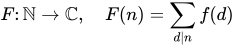
Dann gilt für jede natürliche Zahl

- ,

wobei die Möbiusfunktion auf mit Werten in bezeichnet.


Verallgemeinerung
Beim Nachweis der Umkehrformel wird vom Zielbereich der zahlentheoretischen Funktionen lediglich benutzt, dass eine abelsche Gruppe ist. Für multiplikativ notierte abelsche Gruppen erhält die Möbiussche Umkehrformel also die folgende Form:[1]


Gegeben seien eine zahlentheoretische Funktion

und ihre „summatorische“ Funktion
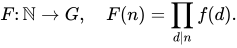
Dann gilt für jede natürliche Zahl

wobei die Möbiusfunktion auf mit Werten in bezeichnet.
Diese Form liefert mit für das Kreisteilungspolynom eine explizite Definition, allerdings im (gebrochen-)rationalen Funktionenkörper , also im Quotientenkörper der Polynomalgebra . Dass und sogar , erfordert weitere, gleichwohl einfache Argumente.[2]

![{\displaystyle \Phi _{n}(X)\in \mathbb {Z} [X]}](https://wikimedia.org/api/rest_v1/media/math/render/svg/7683ba36934319f9841cf56421a7aa941bc5f29d)

![{\displaystyle \mathbb {Q} [X]}](https://wikimedia.org/api/rest_v1/media/math/render/svg/59f611a32bc84287517e9f4b283ac998c0394479)
![{\displaystyle \Phi _{n}(X)\in \mathbb {Q} [X]}](https://wikimedia.org/api/rest_v1/media/math/render/svg/7a773098557d90c03aab9047cec85826171604d8)
Literatur
- Helmut Hasse: Zahlentheorie, 2. erweiterte Auflage, Akademie-Verlag, Berlin, 1963, mit 49 Abbildungen.
Einzelnachweise
- ↑ Helmut Hasse, I. § 2 (Teilbarkeit), Seite 21 unten.
- ↑ Helmut Hasse, III. § 27 (Einheitswurzelkörper), Seite 501.
Content Disclaimer
Informasi ini disarikan dari Wikipedia dan disajikan kembali untuk tujuan edukasi. Konten tersedia di bawah lisensi CC BY-SA 3.0. Kami tidak bertanggung jawab atas ketidakakuratan data yang bersumber dari kontribusi publik tersebut.
- The information displayed on this website is sourced in part or in whole from Wikipedia and has been adapted for the purpose of restating it. We strive to provide accurate and relevant information, however:
- There is no guarantee of absolute accuracy. Wikipedia is an open, collaborative project that can be edited by anyone, so information is subject to change.
- It is not intended to constitute professional advice. The content displayed is for informational and educational purposes only. For important decisions (e.g., medical, legal, or financial), please consult a professional.
- Content copyright. Wikipedia is licensed under the Creative Commons Attribution-ShareAlike License (CC BY-SA). This means that content may be reused with appropriate attribution and shared under a similar license.
- Responsible use. Any risk arising from the use of information from this website is entirely the responsibility of the user.