Mobile Module Connector
Ein Mobile Module Connector (MMC) ist ein von Intel entwickelter Sockel für Prozessormodule in Notebooks.
MMC-1

Zunächst wurde eine erste Generation von Prozessormodulen mit Sockeln nach der Spezifikation MMC-1 angeboten. Zur Anwendung kam er mit den Prozessoren Mobile Pentium, Mobile Pentium MMX und Mobile Pentium II. Der Sockel hatte zwei Steckverbinder mit einem Rastermaß von 0,6 mm mit insgesamt 280 Pins. Auf dem Prozessormodul befanden sich außer dem Prozessor auch die passende Northbridge, Level-2-Cache und CPU-Spannungsregler. Über den MMC-1-Sockel bestand eine PCI-Schnittstelle zur Hauptplatine des Rechners.
- Intel Mobile Pentium II 300 MHz 512kB L2 Cache
-

-

-


MMC-2

Später wurde eine zweite Generation nach der Spezifikation MMC-2 vorgestellt. Der Sockel hatte zehn Reihen mit insgesamt 400 Pins. Zur Anwendung kam er mit den Mobil-Prozessoren Pentium II, Celeron and Pentium III. Neben dem Prozessor befanden sich auf dem Modul weiterhin Northbridge und CPU-Spannungsregler. Der Cache war nur in frühen Exemplaren auf dem Modul bis Prozessoren mit integriertem Cache (On-die Cache) auf den Markt kamen. Zur Hauptplatine bestand eine AGP/PCI-Schnittstelle, die bereits schnelle 3D-Grafik ermöglichte.
- Intel Mobile Pentium III 650 MHz 256kB L2 Cache
-

-
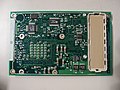
_(15425888118).jpg)
_(15426002407).jpg)
Weblinks

- Uwe v.d. Weyden: Mobile CPU Mania. In: Tomshardware.com vom 7. November 2000
- Intel-Datenblatt zum Pentium II mit MMC-1 (PDF-Datei; 681 kB)
- Intel-Datenblatt zum Pentium II mit MMC-2 (PDF-Datei; 2,9 MB)
Content Disclaimer
Informasi ini disarikan dari Wikipedia dan disajikan kembali untuk tujuan edukasi. Konten tersedia di bawah lisensi CC BY-SA 3.0. Kami tidak bertanggung jawab atas ketidakakuratan data yang bersumber dari kontribusi publik tersebut.
- The information displayed on this website is sourced in part or in whole from Wikipedia and has been adapted for the purpose of restating it. We strive to provide accurate and relevant information, however:
- There is no guarantee of absolute accuracy. Wikipedia is an open, collaborative project that can be edited by anyone, so information is subject to change.
- It is not intended to constitute professional advice. The content displayed is for informational and educational purposes only. For important decisions (e.g., medical, legal, or financial), please consult a professional.
- Content copyright. Wikipedia is licensed under the Creative Commons Attribution-ShareAlike License (CC BY-SA). This means that content may be reused with appropriate attribution and shared under a similar license.
- Responsible use. Any risk arising from the use of information from this website is entirely the responsibility of the user.