Longitudinalmodul
Der Longitudinalmodul , auch longitudinaler Modul oder P-Wellen-Modul genannt, ist einer der Elastizitätsmodule, der in der linearen Elastizitätstheorie zur Beschreibung homogener isotroper Materialien verwendet werden kann.

In einem einachsigen Verzerrungszustand, bei dem alle nicht-axialen Verzerrungen gleich Null sind ( mit ), ist der Longitudinalmodul definiert als das Verhältnis von axialer Spannung zu axialer Verzerrung :


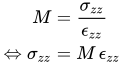
Dies gilt wie gesagt nur, wenn alle Komponenten des Verzerrungstensors bis auf eine Diagonalkomponente Null sind. Wegen seiner Eigenschaft als Diagonalkomponente des Elastizitätstensors wird der Longitudinalmodul gelegentlich auch mit dem Formelzeichen bezeichnet.[1]

Für den Longitudinalmodul gilt:

mit
- der Dichte des Materials
- der Geschwindigkeit der Longitudinalwellen oder P-Wellen.


Daher kann der Longitudinalmodul durch Messung der Geschwindigkeit von Ultraschall in einem Material bestimmt werden.[2]
Außerdem gilt
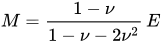
mit
- dem Elastizitätsmodul
- der Poissonzahl .


Bei vernachlässigbarer Querkontraktion () ist .


Siehe auch
Literatur
- G. Mavko, T. Mukerji, J. Dvorkin. The Rock Physics Handbook. Cambridge University Press, 2003, ISBN 0-521-54344-4 (paperback)
Einzelnachweise
- ↑ Thomas Lüthi: Beitrag zur Ermittlung von Eigenspannungen mit Ultraschall: Anwendung auf Schweissnähte. In: Berichte der Eidgenössischen Materialprüfungs- und Forschungsanstalt. Nr. 219. Eidgenössische Materialprüfungs- und Forschungsanstalt, Dübendorf 1990, Teil 1, Abschnitt 1.1 Der Einfluss elastischer Konstanten zweiter Ordnung, S. 2 (Online [PDF]).
- ↑ H. M. Ledbetter: Elastic Constants of Polycrystalline Copper at Low Temperatures. In: physica status solidi (a). 66. Jahrgang, 1981, S. 477–484 (englisch, wiley.com [PDF; abgerufen am 4. Februar 2016]).
Content Disclaimer
Informasi ini disarikan dari Wikipedia dan disajikan kembali untuk tujuan edukasi. Konten tersedia di bawah lisensi CC BY-SA 3.0. Kami tidak bertanggung jawab atas ketidakakuratan data yang bersumber dari kontribusi publik tersebut.
- The information displayed on this website is sourced in part or in whole from Wikipedia and has been adapted for the purpose of restating it. We strive to provide accurate and relevant information, however:
- There is no guarantee of absolute accuracy. Wikipedia is an open, collaborative project that can be edited by anyone, so information is subject to change.
- It is not intended to constitute professional advice. The content displayed is for informational and educational purposes only. For important decisions (e.g., medical, legal, or financial), please consult a professional.
- Content copyright. Wikipedia is licensed under the Creative Commons Attribution-ShareAlike License (CC BY-SA). This means that content may be reused with appropriate attribution and shared under a similar license.
- Responsible use. Any risk arising from the use of information from this website is entirely the responsibility of the user.