Geometrisches Programm
Ein geometrisches Programm ist ein spezielles Problem der mathematischen Optimierung, bei dem als Ziel- und Restriktionsfunktionen eine Verallgemeinerung von Polynomen zum Einsatz kommt. Insbesondere haben Geometrische Programme zwei Formen, von denen aber nur eine zur konvexen Optimierung zählt.
Definition
Ein Optimierungsproblem der Form

heißt geometrisches Programm (in Posynomialform), wenn die Posynomialfunktionen sind und die Monomialfunktionen sind. Die Einschränkung ist hierbei stets implizit vorausgesetzt.



Beispiel
Das Optimierungsproblem

ist ein Geometrisches Programm.
Konvexe Form
Ein Geometrisches Programm lässt sich durch elementare Substitutionen in ein konvexes Optimierungsproblem transformieren.
Dazu setzt man zuerst bzw. . Damit wird jede Monomialfunktion



transformiert zu
- ,
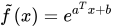
wobei und ist. Posynomialfunktionen lassen sich analog als Summe von Exponentialfunktionen von affinen Funktionen ausdrücken. Durch Anwenden dieser Transformation und anschließendes Logarithmieren erhält man dann das Optimierungsproblem


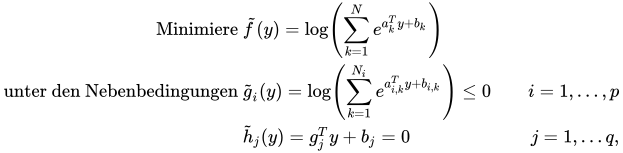
welches Geometrisches Programm in konvexer Form genannt wird. Es ist ein konvexes Optimierungsproblem. Wenn alle Funktionen Monomialfunktionen sind, vereinfacht sich dieses Problem zu einem linearen Optimierungsproblem.
Beispiel für die konvexe Form
Transformiert man das oben angeführte Geometrische Programm in Posynomialform in die Geometrische Form, so lautet es
- .
![{\displaystyle {\begin{aligned}{\text{Minimiere }}&\log \left(\exp {[(1/2,2,0)\cdot y]}+\exp {[(0,-4/3,8)\cdot y]}\right)&\\{\text{unter den Nebenbedingungen }}&\log \left(\exp {[(-1,5,5/7)\cdot y]}+\exp {[(0,0,1)\cdot y]}\right)\leq 0&\\&(1,1,1)\cdot y=0&\end{aligned}}}](https://wikimedia.org/api/rest_v1/media/math/render/svg/d3350f5749ace749d88d534593dfb35efb2ecd6a)
Literatur
- Boyd, Stephen; Vandenberghe, Lieven (2004). Convex Optimization. Cambridge University Press. ISBN 978-0-521-83378-3. (online)
Content Disclaimer
Informasi ini disarikan dari Wikipedia dan disajikan kembali untuk tujuan edukasi. Konten tersedia di bawah lisensi CC BY-SA 3.0. Kami tidak bertanggung jawab atas ketidakakuratan data yang bersumber dari kontribusi publik tersebut.
- The information displayed on this website is sourced in part or in whole from Wikipedia and has been adapted for the purpose of restating it. We strive to provide accurate and relevant information, however:
- There is no guarantee of absolute accuracy. Wikipedia is an open, collaborative project that can be edited by anyone, so information is subject to change.
- It is not intended to constitute professional advice. The content displayed is for informational and educational purposes only. For important decisions (e.g., medical, legal, or financial), please consult a professional.
- Content copyright. Wikipedia is licensed under the Creative Commons Attribution-ShareAlike License (CC BY-SA). This means that content may be reused with appropriate attribution and shared under a similar license.
- Responsible use. Any risk arising from the use of information from this website is entirely the responsibility of the user.