Exponentialsumme
Eine Exponentialsumme ist in der analytischen Zahlentheorie eine endliche Summe der Form
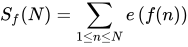
für ein , wobei eine (üblicherweise glatte) Funktion und ist.

![{\displaystyle f:[1,N]\to \mathbb {R} }](https://wikimedia.org/api/rest_v1/media/math/render/svg/f5656fbf73ac8772c6884e70b72b427f79215491)
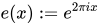
Exponentialsummen werden insbesondere in der russischen Literatur (z. B. bei Iwan Winogradow) auch als trigonometrische Summen bezeichnet.
Ist ein reelles Polynom, so bezeichnet man auch als Weyl-Summe, benannt nach Hermann Weyl.[1]


Eigenschaften
Die Funktion nennt man additiver Charakter auf , nennt man Amplitudenfunktion und Länge der Summe.


Der Shift des Argumentes wird mit

notiert, wobei nun auf dem Interval definiert sein muss.
![{\displaystyle [M+1,M+N]}](https://wikimedia.org/api/rest_v1/media/math/render/svg/c2cf2a8a5d2d4947da12ea468fd1123907dd18ca)
Komplexe Verallgemeinerung
Exponentialsummen können für eine reelle Folge auch auf

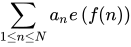
verallgemeinert werden. Dies entspricht der obigen Definition der Exponentialsumme mit einer komplexen Funktion , denn es gilt
![{\displaystyle g:[1,N]\to \mathbb {C} }](https://wikimedia.org/api/rest_v1/media/math/render/svg/9ffe439f713ed616a61eab755ac87e59664c2a5a)

und somit gilt

Noch allgemeiner definiert man

für eine beliebige komplex-wertige Funktion und eine reell-wertige Funktion .[2]


Geschichte
Weyl veröffentlichte 1916 als Erster eine Anwendung von Exponentialsummen in der Zahlentheorie (siehe Gleichverteilung modulo 1).[3] 1921 entwickelte er eine Methode um Weyl-Summen abzuschätzen, welche heute als Weyls Methode bezeichnet wird.[4]
1921[5] und 1922[6] veröffentlichte Johannes van der Corput zwei Arbeiten, aus der eine weitere Methode zur Abschätzung von Exponentialsummen hervorging und heute als Van der Corputs Methode bezeichnet wird.
1935[7] und 1936[8] veröffentlichte Iwan Winogradow eine weitere Methode zur Abschätzung von Weyl-Summen.[9] Zusätzlich veröffentlichte er 1937 eine Methode zur Abschätzung von Exponentialsummen mit Primzahlen.[10][11] Beide Methoden werden heute als Winogradows Methode bezeichnet.
Literatur
- Henryk Iwaniec und Emmanuel Kowalski: Analytic Number Theory. In: American Mathematical Society (Hrsg.): Colloquium Publications. Band 53, 2004, ISBN 0-8218-3633-1, S. 197–227.
- Arkhipov, G. I. und Chubarikov, V. N. und Karatsuba, A. A.: Trigonometric sums in number theory and analysis. Transl. from the Russian. In: Berlin: Walter de Gruyter (Hrsg.): De Gruyter Expo. Math. Band 39, 2004, ISBN 3-11-019798-7, doi:10.1515/9783110197983.
Einzelnachweise
- ↑ B. M. Bredikhin: Weyl sum. In: encyclopediaofmath.org. Encyclopedia of Mathematics, abgerufen am 8. Januar 2023.
- ↑ A. A. Karatsuba: Trigonometric sum. In: encyclopediaofmath.org. Encyclopedia of Mathematics, abgerufen am 8. Januar 2023.
- ↑ Hermann Weyl: Über die Gleichverteilung von Zahlen mod. Eins. In: Math. Ann. Band 77, 1916, S. 313–352.
- ↑ Hermann Weyl: Zur Abschatzung von . In: Math. Zeit. Band 10, 1921, S. 88–101.
- ↑ J. G. van der Corput: Zahlentheoretische Abschätzungen. In: Mathematische Annalen. Band 84, 1921, S. 53–79 (eudml.org).
- ↑ J. G. van der Corput: Verschärfung der Abschätzung beim Teilerproblem. In: Math. Ann. Band 87, 1922, S. 39–65, doi:10.1007/BF01458035.
- ↑ I. M . Winogradow: On Weyl's sums. In: Mat. Sbornik. Band 42, 1935, S. 521–530.
- ↑ I. M . Winogradow: A new method of estimation of trigonometrical sums. In: Mat. Sbornik. Band 43, Nr. 1, 1936, S. 175–188.
- ↑ Henryk Iwaniec und Emmanuel Kowalski: Analytic Number Theory. In: American Mathematical Society (Hrsg.): Colloquium Publications. Band 53, 2004, ISBN 0-8218-3633-1, S. 197–227.
- ↑ I. M . Winogradow: The representation of an odd number as a sum of three prime numbers. In: Dokl. Akad. Nauk SSSR. Band 15, Nr. 2, 1937, S. 291–294.
- ↑ I. M . Winogradow: Some theorems concerning the theory of prime numbers. In: Mat. Sb. Band 44, Nr. 2, 1937, S. 179–196.

Content Disclaimer
Informasi ini disarikan dari Wikipedia dan disajikan kembali untuk tujuan edukasi. Konten tersedia di bawah lisensi CC BY-SA 3.0. Kami tidak bertanggung jawab atas ketidakakuratan data yang bersumber dari kontribusi publik tersebut.
- The information displayed on this website is sourced in part or in whole from Wikipedia and has been adapted for the purpose of restating it. We strive to provide accurate and relevant information, however:
- There is no guarantee of absolute accuracy. Wikipedia is an open, collaborative project that can be edited by anyone, so information is subject to change.
- It is not intended to constitute professional advice. The content displayed is for informational and educational purposes only. For important decisions (e.g., medical, legal, or financial), please consult a professional.
- Content copyright. Wikipedia is licensed under the Creative Commons Attribution-ShareAlike License (CC BY-SA). This means that content may be reused with appropriate attribution and shared under a similar license.
- Responsible use. Any risk arising from the use of information from this website is entirely the responsibility of the user.