Dunkl-Operator
Der Dunkl-Operator ist ein Differential-Differenz-Operator aus der Lie-Theorie, der einer endlichen Reflexionsgruppe eines Wurzelsystems zugeordnet ist. Er wurde 1989 von dem amerikanischen Mathematiker Charles F. Dunkl eingeführt.[1]
In der Stochastik untersucht man die Dunkl-Prozesse, die càdlàg Markow-Prozesse sind, deren infinitesimaler Generator eine Summe von Dunkl-Operatoren ist.
Dunkl-Operator
Wir betrachten mit euklidischem Skalarprodukt und Skalarproduktnorm .


Sei
- ein Wurzelsystem in ,
- ein positives Teilsystem von ,
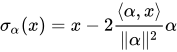
- die Spiegelungsgruppe von , d. h. die Gruppe, die durch die Spiegelungen , definiert durch


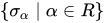
- ,
- erzeugt wird,
- eine Multiplizitätsfunktion, d. h. eine Funktion auf dem Wurzelsystem, die invariant unter ist, d. h. . Die Menge aller Multiplizitätsfunktionen bezeichnen wir mit ,
- die Richtungsableitung bezüglich eines Vektores .




Dunkl-Operator
Sei nun und und . Der zugehörige Dunkl-Operator ist definiert durch[2]



Da noch weitere Dunkl-Operatoren existieren, nennt man diesen auch rationaler Dunkl-Operator.
Eigenschaften
Für ein fixes kommutiert der Dunkl-Operator, d. h für und gilt[3]



Dunkl-Prozess
Für eine nichtnegative Multiplizitätsfunktion und Standardvektoren definieren wir nun die Dunkl-Operatoren definiert für durch



Der Dunkl-Laplace-Operator ist definiert als
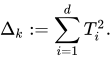
Der Dunkl-Prozess ist der Markow-Prozess mit dem infinitesimalen Generator[4]


Beispiel
Für , eine Multiplizitätsfunktion und einen Dunkl-Prozess lautet der infinitesimale Generator explizit


![{\displaystyle Lu(x)={\frac {1}{2}}\Delta u(x)+\sum _{\alpha \in R_{+}}k(\alpha )\left[{\frac {\langle \nabla u(x),\alpha \rangle }{\langle \alpha ,x\rangle }}+{\frac {u(\sigma _{\alpha }x)-u(x)}{\langle \alpha ,x\rangle ^{2}}}\right],}](https://wikimedia.org/api/rest_v1/media/math/render/svg/a5b173994d5e650abe3339ec8fa490e00209cf7e)
wobei den gewöhnlichen Laplace-Operator auf bezeichnet.[4]

Literatur
- Charles F. Dunkl: Differential-difference operators associated to reflection groups. In: Transactions of the American Mathematical Society. Band 311, Nr. 1, 1989, ISSN 0002-9947, S. 167–183, doi:10.2307/2001022.
- Margit Rösler: Dunkl Operators: Theory and Applications. 2002, doi:10.48550/ARXIV.MATH/0210366.
Dunkl-Prozesse
- Léonard Gallardo, Marc Yor: A chaotic representation property of the multidimensional Dunkl processes. In: Institute of Mathematical Statistics (Hrsg.): The Annals of Probability. Band 34, Nr. 4, 2006, S. 1530–1549, doi:10.1214/009117906000000133.
- Margit Rösler, Michael Voit: Markov Processes Related with Dunkl Operators. In: Advances in Applied Mathematics. Band 21, Nr. 4, 1998, S. 575–643, doi:10.1006/aama.1998.0609 (sciencedirect.com).
Einzelnachweise
- ↑ Charles F. Dunkl: Differential-difference operators associated to reflection groups. In: Transactions of the American Mathematical Society. Band 311, Nr. 1, 1989, ISSN 0002-9947, S. 167–183, doi:10.2307/2001022.
- ↑ Margit Rösler: Dunkl Operators: Theory and Applications. 2002, doi:10.48550/ARXIV.MATH/0210366.
- ↑ Charles F. Dunkl: Differential-difference operators associated to reflection groups. In: Transactions of the American Mathematical Society. Band 311, Nr. 1, 1989, ISSN 0002-9947, S. 171, doi:10.2307/2001022 (Theorem 1.9).
- ↑ a b Léonard Gallardo und Marc Yor: A chaotic representation property of the multidimensional Dunkl processes. In: Institute of Mathematical Statistics (Hrsg.): The Annals of Probability. Band 34, Nr. 4, 2006, S. 1530–1549, doi:10.1214/009117906000000133.
Content Disclaimer
Informasi ini disarikan dari Wikipedia dan disajikan kembali untuk tujuan edukasi. Konten tersedia di bawah lisensi CC BY-SA 3.0. Kami tidak bertanggung jawab atas ketidakakuratan data yang bersumber dari kontribusi publik tersebut.
- The information displayed on this website is sourced in part or in whole from Wikipedia and has been adapted for the purpose of restating it. We strive to provide accurate and relevant information, however:
- There is no guarantee of absolute accuracy. Wikipedia is an open, collaborative project that can be edited by anyone, so information is subject to change.
- It is not intended to constitute professional advice. The content displayed is for informational and educational purposes only. For important decisions (e.g., medical, legal, or financial), please consult a professional.
- Content copyright. Wikipedia is licensed under the Creative Commons Attribution-ShareAlike License (CC BY-SA). This means that content may be reused with appropriate attribution and shared under a similar license.
- Responsible use. Any risk arising from the use of information from this website is entirely the responsibility of the user.