Darwin-Term
Der Darwin-Term (nach Charles Galton Darwin) ist ein relativistischer Korrekturterm im Hamiltonoperator , um die Feinstruktur im Wasserstoffspektrum theoretisch zu erklären. Er ergibt sich aus der Dirac-Theorie.


Er beschreibt, dass in nicht-relativistischer Näherung die elektrostatische Wechselwirkung des Elektrons mit dem elektrischen Feld des Kerns aufgrund der Zitterbewegung nicht mehr lokal ist, sondern auch von einem kleinen Bereich des elektrischen Feldes um das Elektron herum abhängt:
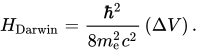
Da das Potential ein Coulomb-Potential ist, kann der Darwin-Term auch geschrieben werden als

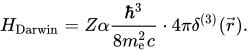
Dabei ist
- die Feinstrukturkonstante
- die reduzierte Planck-Konstante
- die Masse des Elektrons
- die Lichtgeschwindigkeit
- der Laplace-Operator
- die Kernladungszahl
- die Delta-Distribution in drei Dimensionen.


Der Darwin-Term spielt nur bei Elektronen mit Drehimpulsquantenzahl eine Rolle, weil nur deren Wellenfunktionen am Kernort () nicht verschwinden.[1]


Heuristische Herleitung
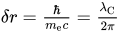
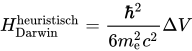
Der Darwin-Term kann im relativistischen Wasserstoffproblem formal stringent hergeleitet werden, indem die relativistische Korrektur und die Spin-Bahn-Kopplung vom Gesamtergebnis subtrahiert werden. Eine heuristische Herleitung nimmt an, dass das Elektron nicht exakt lokalisiert ist, sondern seine Position um , die reduzierte Compton-Wellenlänge des Elektrons, schwankt. Eine solche Herleitung führt nicht exakt auf den korrekten Darwin-Term, sondern nur auf die richtige Größenordnung
- .
Literatur
- Armin Wachter: Relativistische Quantenmechanik. Springer, Berlin/Heidelberg 2005, ISBN 3-540-22922-1, S. 167.
Einzelnachweise
- ↑ Ingolf V. Hertel, Claus-Peter Schulz: Atome, Moleküle und optische Physik 1 – Atomphysik und Grundlagen der Spektroskopie. Springer, Berlin/Heidelberg 2008, ISBN 978-3-540-30613-9, S. 221.
Content Disclaimer
Informasi ini disarikan dari Wikipedia dan disajikan kembali untuk tujuan edukasi. Konten tersedia di bawah lisensi CC BY-SA 3.0. Kami tidak bertanggung jawab atas ketidakakuratan data yang bersumber dari kontribusi publik tersebut.
- The information displayed on this website is sourced in part or in whole from Wikipedia and has been adapted for the purpose of restating it. We strive to provide accurate and relevant information, however:
- There is no guarantee of absolute accuracy. Wikipedia is an open, collaborative project that can be edited by anyone, so information is subject to change.
- It is not intended to constitute professional advice. The content displayed is for informational and educational purposes only. For important decisions (e.g., medical, legal, or financial), please consult a professional.
- Content copyright. Wikipedia is licensed under the Creative Commons Attribution-ShareAlike License (CC BY-SA). This means that content may be reused with appropriate attribution and shared under a similar license.
- Responsible use. Any risk arising from the use of information from this website is entirely the responsibility of the user.