Approximative Pivotstatistik
Eine approximative Pivotstatistik ist eine Folge von Funktionen in der mathematischen Statistik, die zur Konstruktion von approximativen Konfidenzbereichen verwendet wird. Sie bildet somit das asymptotische Pendant zur Pivotstatistik, welche zur Konstruktion von (nichtapproximativen) Konfidenzbereichen verwendet wird.
Definition
Rahmenbedingungen
Für seien Messräume und Familien von Wahrscheinlichkeitsmaßen auf . Sei ein weiterer Messraum sowie


die zu schätzende Funktion.
In den meisten Fällen handelt es sich bei den Messräumen und den Familien von Wahrscheinlichkeitsmaßen um -fache Produktmodelle. Typisches Beispiel hierfür wäre und als Wahrscheinlichkeitsmaß ein entsprechendes Produktmaß eines Wahrscheinlichkeitsmaßes auf .


Formalisierung
Eine Folge von Statistiken mit


heißt eine approximative Pivotstatistik für , wenn gilt:

- Es existiert eine Wahrscheinlichkeitsverteilung auf , so dass die Verteilung von für alle gegen konvergiert. Es ist also


- für und für alle .


- Für alle Mengen ist in enthalten.



Die zweite Bedingung garantiert, dass allen Mengen in sinnvoll Wahrscheinlichkeiten durch die Wahrscheinlichkeitsmaße zugeordnet werden können, das heißt die Verteilung von für alle wohldefiniert ist.


Beispiel
Betrachte ein Bernoulli-Produktmodell, also

versehen mit der Bernoulli-Verteilung zum Parameter .

Das -fache Produktmodell ist dann . Geschätzt werden soll der Parameter der Bernoulli-Verteilung, also ist die zu schätzende Funktion

- .

Sei die Stichprobenvariable. Die sind unabhängig identisch verteilt und es ist


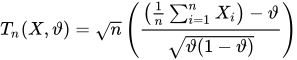
eine approximative Pivotstatistik, da sie nach dem Satz von Moivre-Laplace gegen die Standardnormalverteilung konvergiert. Es ist also .

Quellen
- Ludger Rüschendorf: Mathematische Statistik. Springer Verlag, Berlin Heidelberg 2014, ISBN 978-3-642-41996-6, S. 233–236, doi:10.1007/978-3-642-41997-3.
- Claudia Czado, Thorsten Schmidt: Mathematische Statistik. Springer-Verlag, Berlin Heidelberg 2011, ISBN 978-3-642-17260-1, S. 144–145, doi:10.1007/978-3-642-17261-8.
Content Disclaimer
Informasi ini disarikan dari Wikipedia dan disajikan kembali untuk tujuan edukasi. Konten tersedia di bawah lisensi CC BY-SA 3.0. Kami tidak bertanggung jawab atas ketidakakuratan data yang bersumber dari kontribusi publik tersebut.
- The information displayed on this website is sourced in part or in whole from Wikipedia and has been adapted for the purpose of restating it. We strive to provide accurate and relevant information, however:
- There is no guarantee of absolute accuracy. Wikipedia is an open, collaborative project that can be edited by anyone, so information is subject to change.
- It is not intended to constitute professional advice. The content displayed is for informational and educational purposes only. For important decisions (e.g., medical, legal, or financial), please consult a professional.
- Content copyright. Wikipedia is licensed under the Creative Commons Attribution-ShareAlike License (CC BY-SA). This means that content may be reused with appropriate attribution and shared under a similar license.
- Responsible use. Any risk arising from the use of information from this website is entirely the responsibility of the user.