Antonelli-Matrix
Als Antonelli-Matrix bezeichnet man in der Volkswirtschaftslehre und speziell in der Mikroökonomik die Hesse-Matrix der Distanzfunktion.[1]
Definition und Bedeutung
Mit n der Zahl der Güter ist die Antonelli-Matrix A eine -Matrix, deren (i,j)-ter Eintrag durch den Ausdruck


gegeben ist. Die Matrix stellt sich entsprechend folgendermaßen dar:
- .
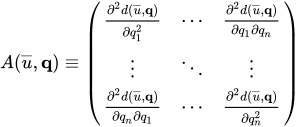
Dabei bezeichnet die so genannte Distanzfunktion zum spezifischen Nutzenniveau und dem n-Vektor der Gütermengen, . Die Distanzfunktion gibt die Zahl an, durch die geteilt werden muss, damit die verbleibende Kombination von Gütermengen gerade auf der Indifferenzkurve liegt.[2]




Der (i,j)-te Eintrag der Antonelli-Matrix gibt nun an, wie stark sich der Preis, den ein Haushalt für eine Mehreinheit von i zu zahlen bereit wäre, ändert, wenn seine Nachfrage nach Gut j exogen erhöht wird, er aber weiterhin auf derselben Indifferenzkurve verbleiben möchte.[3]
Eigenschaften und Zusammenhang zu verwandten Konzepten
Die Antonelli-Matrix ist unter gängigen Annahmen über die Distanzfunktion symmetrisch.[4] Zudem handelt es sich bei ihr um die Pseudoinverse der Slutsky-Matrix.[5]
Literatur
- Michael Ahlheim: Measures of Economic Welfare. In: Salvador Barberà, Peter J. Hammond und Christian Seidl (Hrsg.): Handbook of Utility Theory. Bd. 1. Kluwer Academic Publishers, Boston 1998, ISBN 0-7923-8174-2, S. 483–568.
- Giovanni B. Antonelli: Sulla Teoria Mathematica della Economia Politica. Pisa 1886. [Eine Übersetzung ins Englische ist unter dem Titel On the Mathematical Theory of Political Economy enthalten in John S. Chipman u. a. (Hrsg.): Preferences, Utility and Demand. Harcourt Brace Jovanovich, New York 1971, Kapitel 16.]
- Angus Deaton: The Distance Function in Consumer Behaviour with Applications to Index Numbers and Optimal Taxation. In: The Review of Economic Studies. 46, Nr. 3, 1979, S. 391–405 (JSTOR:2297009).
- Nicholas Stern: A Note on Commodity Taxation: The Choice of Variable and the Slutsky, Hessian and Antonelli Matrices (SHAM). In: The Review of Economic Studies. 53, Nr. 2, 1986, S. 293–299 (JSTOR:2297653).
Einzelnachweise
- ↑ Vgl. Ahlheim 1998, S. 494; Deaton 1979, S. 394.
- ↑ Vgl. Angus Deaton und John Muellbauer: Economics and consumer behavior. Cambridge University Press, Cambridge u. a. 1980, ISBN 0-521-22850-6, S. 54 ff.
- ↑ Vgl. Angus Deaton und John Muellbauer: Economics and consumer behavior. Cambridge University Press, Cambridge u. a. 1980, ISBN 0-521-22850-6, S. 57.
- ↑ Vgl. Ahlheim 1998, S. 494; Deaton 1979, S. 394.
- ↑ Vgl., jeweils auch zur Herleitung, Deaton 1979, S. 395 f. sowie Stern 1986, S. 295.
Content Disclaimer
Informasi ini disarikan dari Wikipedia dan disajikan kembali untuk tujuan edukasi. Konten tersedia di bawah lisensi CC BY-SA 3.0. Kami tidak bertanggung jawab atas ketidakakuratan data yang bersumber dari kontribusi publik tersebut.
- The information displayed on this website is sourced in part or in whole from Wikipedia and has been adapted for the purpose of restating it. We strive to provide accurate and relevant information, however:
- There is no guarantee of absolute accuracy. Wikipedia is an open, collaborative project that can be edited by anyone, so information is subject to change.
- It is not intended to constitute professional advice. The content displayed is for informational and educational purposes only. For important decisions (e.g., medical, legal, or financial), please consult a professional.
- Content copyright. Wikipedia is licensed under the Creative Commons Attribution-ShareAlike License (CC BY-SA). This means that content may be reused with appropriate attribution and shared under a similar license.
- Responsible use. Any risk arising from the use of information from this website is entirely the responsibility of the user.