Yesnaby
| Yesnaby | |
|---|---|
 | |
  Yesnaby Location within Orkney | |
| Civil parish | |
| Council area | |
| Country | Scotland |
| Sovereign state | United Kingdom |
| Police | Scotland |
| Fire | Scottish |
| Ambulance | Scottish |


Yesnaby (historic: Yeskenaby, Yestnaby) is a historic township[1][2] in Sandwick, on the west coast of Orkney Mainland, Scotland, south of Skara Brae. It is renowned for its spectacular Old Red Sandstone coastal cliff scenery which includes sea stacks, blowholes, geos and frequently boiling seas. A car park, coastal trail and interpretive panels serve visitors. The area is popular with climbers because of Yesnaby Castle, a two-legged sea stack just south of the Brough of Bigging. The stack is sometimes described as a smaller version of the Old Man of Hoy.[citation needed] Yesnaby is also one of the very few places where Primula scotica grows.
Geology
The coastal cliffs are formed from the Lower Devonian sandstones ascribed to the Yesnaby Sandstone Group - a set of geological formations restricted to the Yesnaby area, and to the overlying beds of the Lower Stromness Flagstones. Fossil stromatolites from 390 to 400 million years ago can be found in the cliffs in the latter. They are locally known as Horse Tooth Stones from a supposed resemblance.[citation needed]
Culture
Orkney folklore has it that a woman known as the "Yesnaby Healer" had the ability to stop bleeding in any person, even over a distance. The Orkney composer Peter Maxwell Davies has immortalised Yesnaby through "Yesnaby Ground", an Interlude for solo piano.
The Archaeology Institute of the University of the Highlands and Islands initiated the Yesnaby Art & Archaeology Research Project[3]
History
During the Second World War an anti-aircraft battery was built on the cliff top at Yesnaby as part of the defences of the Royal Navy base at Scapa Flow. The battery was manned by the Royal Navy and some traces of the wartime buildings remain.[4]
Photo gallery
-
 Panorama of Yesnaby
 -
 Sea cliffs
 -
 Puffin
 -
 Geo (inlet)
 -
 Black Guillemots
 -
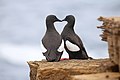 Black Guillemots in summer plumage
 -
 Cliff
Cliff -
 Cliffs
 -
 Cliff
Cliff -
 Cliffs


References
- ^ Samuel Lewis (1846). A Topographical Dictionary of Scotland: From Abbey to Jura, Vol I. p. 646.
- ^ Samuel Lewis (1846). A Topographical Dictionary of Scotland, Vol II. p. 452.
- ^ "Facebook". Facebook.
- ^ Miller, James (2001). Scapa, Britain's Famous Wartime Naval Base. Birlinn. pp. 99–101. ISBN 1843410052.
External links

- Yesnaby Geology Map Archived 5 March 2016 at the Wayback Machine
- A Climber's Guide to Orkney
- Official Orkney Tourism site Archived 24 June 2008 at the Wayback Machine
- Wichcraft in the Orkney Isles: The Yesnaby Healer Archived 11 May 2008 at the Wayback Machine


Content Disclaimer
Informasi ini disarikan dari Wikipedia dan disajikan kembali untuk tujuan edukasi. Konten tersedia di bawah lisensi CC BY-SA 3.0. Kami tidak bertanggung jawab atas ketidakakuratan data yang bersumber dari kontribusi publik tersebut.
- The information displayed on this website is sourced in part or in whole from Wikipedia and has been adapted for the purpose of restating it. We strive to provide accurate and relevant information, however:
- There is no guarantee of absolute accuracy. Wikipedia is an open, collaborative project that can be edited by anyone, so information is subject to change.
- It is not intended to constitute professional advice. The content displayed is for informational and educational purposes only. For important decisions (e.g., medical, legal, or financial), please consult a professional.
- Content copyright. Wikipedia is licensed under the Creative Commons Attribution-ShareAlike License (CC BY-SA). This means that content may be reused with appropriate attribution and shared under a similar license.
- Responsible use. Any risk arising from the use of information from this website is entirely the responsibility of the user.