User:Skangaroo
Reduced Magnetohydrodynamics
Reduced Magnetyhdrodynamics (RMHD) is a set of four equations derived from the resistive MHD equations. It reduces the free paramameters of the equations down to four independent scalar variables and thus provides closure of MHD. It is important for investigations on linear and nonlinear plasma dynamics in Tokamak geometry and numerical simulations. The model was first developped by Strauß in 1976[1].
[2].
Outline of derivation
Multiscale expansion
Time and space are expanded on multiple scales as


- and


within a small parameter where and denote a fast varying scale and and a slowly varying scale. The magnetic field , electric field , current density , bulk fluid velocity , plamsa pressure and plasma density from the MHD model are exanded in similar to:



This practically means that an equilibrium solution of the MHD model only varies on the slow scale whereas perturbations to this equilibrium can vary on both fast and slow scales. In particular are all fast derivatives of order quantaties equal to zero.

Flute Approximation
It is assumed that fast spatial variations are only possible in the plane perpendicular to the equilibrium magnetic field:

This is the only additional assumption used and currently referred to as Flute Approximation.
Closure of the equations
The electromagnetic fields are expressed by an electrostatic potential and a vectorpotential


- and

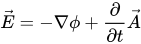
Then all expanded quantaties are inserted into the resistive MHD equations. Since every order in epsilon is assumed to be an order of magnitude smaller than the previous ones, all terms of equal order in have to balance each other. By going through the equations order by order in some quantaties are found to be equal to zero or directly related to others. As independent variables remain the four following scalars:
- , the lowest order pressure pertubation
- , the second order electrostatic potential perturbation
- , the component parallel to the magnetic field of the second order vectorpotential
- , the lowest order velocity perturbation parallel to the magnetic Field


The evolution of these quantaties is governed by the following set of four coupled differential equations.
RMHD equations
![{\displaystyle {\begin{aligned}&{\frac {\partial \psi _{2}}{\partial \tau }}+\left({\vec {b}}_{0}\cdot {\frac {\partial }{\partial {\vec {X}}}}-{\frac {{\vec {b}}_{0}}{B_{0}}}\cdot {\frac {\partial \psi _{2}}{\partial {\vec {\xi }}}}\right)\phi _{2}={\frac {\eta }{\mu _{0}}}{\frac {\partial ^{2}\psi _{2}^{2}}{\partial {\vec {\xi }}^{2}}}&(1)\\&\rho _{0}\left({\frac {\partial }{\partial \tau }}+{\vec {V}}_{E}\cdot {\frac {\partial }{\partial {\vec {\xi }}}}\right)V_{1\parallel }=-\left({\vec {b}}_{0}\cdot {\frac {\partial }{\partial {\vec {X}}}}-{\frac {{\vec {b}}_{0}}{B_{0}}}\cdot {\frac {\partial \psi _{2}}{\partial {\vec {\xi }}}}\times {\frac {\partial }{\partial {\vec {\xi }}}}\right)P_{1}+{\frac {{\vec {b}}_{0}}{B_{0}}}\cdot {\frac {\partial \psi _{2}}{\partial {\vec {x}}}}\times {\frac {\partial P_{0}}{\partial {\vec {X}}}}+\mu _{\perp }{\frac {\partial ^{2}V_{1\parallel }}{\partial {\vec {\xi }}^{2}}}&(2)\\&\rho _{0}\left({\frac {\partial }{\partial \tau }}+{\vec {V}}_{E}\cdot {\frac {\partial }{\partial {\vec {\xi }}}}\right){\frac {\partial ^{2}\phi _{2}}{\partial {\vec {\xi }}^{2}}}=2B_{0}{\vec {b}}_{0}\times {\vec {\kappa }}_{0}\cdot {\frac {\partial P_{1}}{\partial {\vec {\xi }}_{\perp }}}-{\frac {B_{0}^{2}}{\mu _{0}}}\left(b_{0}\cdot {\frac {\partial }{\partial {\vec {X}}}}-{\frac {{\vec {b}}_{0}}{B_{0}}}\cdot {\frac {\partial \psi _{2}}{\partial {\vec {\xi }}}}\times {\frac {\partial }{\partial {\vec {\xi }}}}\right){\frac {\partial ^{2}\psi _{2}}{\partial {\vec {\xi }}^{2}}}+\mu _{\perp }{\frac {\partial ^{4}\phi _{2}}{\partial {\vec {\xi }}^{4}}}&(3)\\&\left(1+{\frac {5}{3}}{\frac {\mu _{0}P_{0}}{B_{0}^{2}}}\right)\left({\frac {\partial P_{1}}{\partial \tau }}+{\vec {V}}_{E}\cdot {\frac {\partial P_{1}}{\partial {\vec {\xi }}}}+{\vec {V}}_{E}\cdot {\frac {\partial P_{0}}{\partial {\vec {X}}}}\right)={\frac {5}{3}}P_{0}\left[{\frac {2}{B_{0}}}{\vec {b}}_{0}\cdot \kappa _{0}\times {\frac {\partial \phi _{2}}{\partial {\vec {X}}}}-\left({\vec {b}}_{0}\cdot {\frac {\partial }{\partial {\vec {X}}}}-{\frac {{\vec {b}}_{0}}{B_{0}}}\cdot {\frac {\partial \psi _{2}}{\partial \xi }}\times {\frac {\partial }{\partial {\vec {\xi }}}}\right)V_{1\parallel }+V_{1\parallel }{\vec {b}}_{0}\cdot {\frac {\partial \ln B_{0}}{\partial {\vec {X}}}}+{\frac {\eta }{B_{0}^{2}}}{\frac {\partial ^{2}P_{1}}{\partial {\vec {\xi }}^{2}}}\right]+\chi {\frac {\partial ^{2}P_{1}}{\partial {\vec {\xi }}^{2}}}&(4)\end{aligned}}}](https://wikimedia.org/api/rest_v1/media/math/render/svg/112bf5c035ed65d9079e753550c4c955ba8bbaa2)
Here it is assumed that an equilibrium solution of the MHD model is known and thus all quantaties denoted by a subscript. is the curvature vector of the 0th order magnetic field. is the magnetic constant and the plasma's resistivity which is assumed to be small. is the leading order viscosity and the heat diffusivity. is the electric drift. The particle density in these equations is a passive scalar and thus can be assumed constant.


In the above set of equations only fast time derivatives occur. Hence they solely describe fast dynamics along the slowly varying equilbrium magnetic field. Thus Magnetosonic waves, which constraine the computational speed of the original MHD model are eliminated[3].
Low Beta RMHD
In the limit of low Beta the equations simplify further. By normalizing the prefactor on the right hand side of equation (4) with a characteristic magnetic pressure it gets the plasma beta as a prefactor. By assuming an ordering of everything but the diffusion term on the rhs can be ignored. Then equation (4) simplifies to


- .

Now only equation (2) contains the velocity perturbation and it decouples from the rest of equations. Thus low beta RMHD contains only the equations (1), (3) and (4b) for the three variables P1, Φ2 and ψ2.
References
https://web2.ph.utexas.edu/~morrison/84POF_morrison.pdf
- ^ Strauß, H.R. (1976). "original article on RMHD". Phys. Fluids. 19 (134).
- ^ http://journals.cambridge.org/download.php?file=%2FPLA%2FPLA48_01%2FS002237780001638Xa.pdf&code=9590642265972bc20e528452fc6608c7
- ^ Kruger, S.E.; Hegna, C.C.; Callen, J.D. "Reduced MHD equations for low aspect ratio plasmas" (PDF). University of Wisconsin. Retrieved 27 April 2015.
Content Disclaimer
Informasi ini disarikan dari Wikipedia dan disajikan kembali untuk tujuan edukasi. Konten tersedia di bawah lisensi CC BY-SA 3.0. Kami tidak bertanggung jawab atas ketidakakuratan data yang bersumber dari kontribusi publik tersebut.
- The information displayed on this website is sourced in part or in whole from Wikipedia and has been adapted for the purpose of restating it. We strive to provide accurate and relevant information, however:
- There is no guarantee of absolute accuracy. Wikipedia is an open, collaborative project that can be edited by anyone, so information is subject to change.
- It is not intended to constitute professional advice. The content displayed is for informational and educational purposes only. For important decisions (e.g., medical, legal, or financial), please consult a professional.
- Content copyright. Wikipedia is licensed under the Creative Commons Attribution-ShareAlike License (CC BY-SA). This means that content may be reused with appropriate attribution and shared under a similar license.
- Responsible use. Any risk arising from the use of information from this website is entirely the responsibility of the user.